Abbott’s Amplatzer Paraclose PVL Occluder offers a minimally invasive alternative for patients who develop a significant complication following heart valve replacement surgery.
Heart valve replacement surgery can be lifesaving for patients with damaged or diseased heart valves. But even after a successful procedure, some patients develop a complication that may require additional treatment—or another major operation.
On October 27, 2026, the U.S. Food and Drug Administration (FDA) approved Abbott Medical’s Amplatzer Paraclose PVL Occluder, a device designed to close leaks that develop around surgically implanted replacement heart valves.
According to Abbott, it is the first FDA-approved transcatheter device in the United States specifically designed to treat these leaks.
When a Replacement Heart Valve Develops a Leak
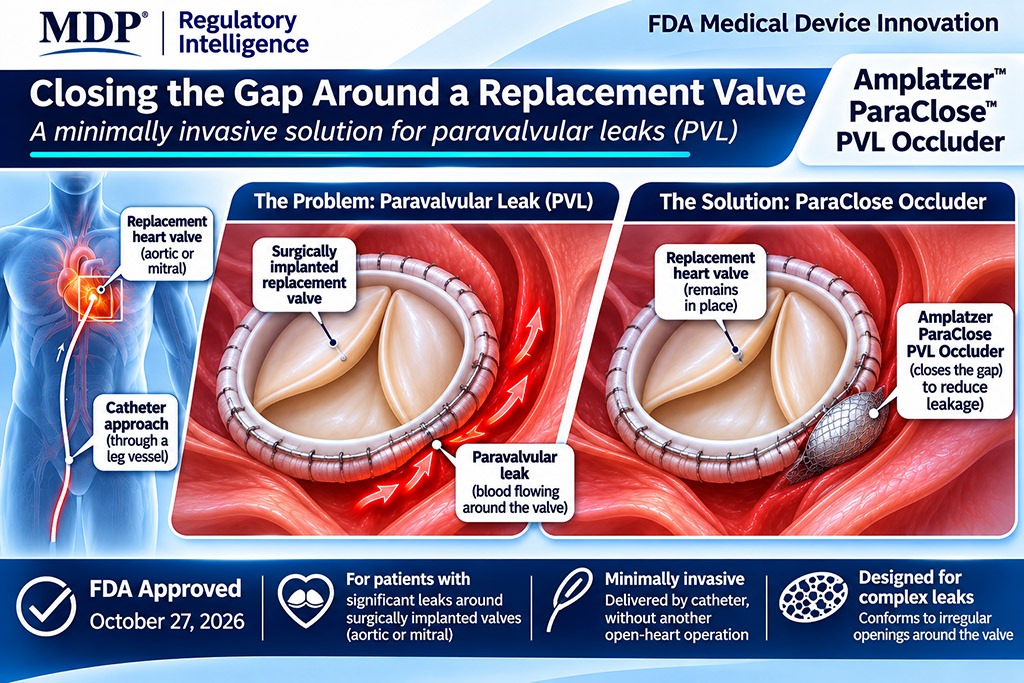
Replacement heart valves are designed to restore normal blood flow through the heart. However, a small gap can sometimes remain or develop between the replacement valve and the surrounding heart tissue. This condition, called a paravalvular leak (PVL), allows blood to flow backward around the replacement valve rather than passing through it normally.
Abbott reports that paravalvular leaks occur in approximately 7% to 17% of mitral valve replacements and 5% to 10% of aortic valve replacements. Not all leaks require treatment, but clinically significant leaks can cause serious complications.
Patients may experience shortness of breath, fatigue, swelling, and other symptoms associated with heart failure. Leaks can also damage circulating red blood cells, potentially causing anemia. For patients who require treatment, another open-heart operation may carry substantial risks, particularly when they have other medical conditions.
Closing the Leak Without Another Open-Heart Operation
The Amplatzer Paraclose PVL Occluder provides a less invasive approach. Rather than reopening the chest, a physician inserts a catheter through a blood vessel in the patient’s leg and guides the device to the affected heart valve.
The occluder is positioned within the gap between the replacement valve and surrounding tissue, where it expands to help stop the abnormal blood flow. Its specialized oblong shape is designed to accommodate the irregular openings that can develop around replacement valves.
FDA approved the device for patients with clinically significant paravalvular leaks associated with surgically implanted aortic or mitral valve prostheses. The device is intended to treat leaks around existing replacement valves, not to replace the valves themselves.
Clinical Evidence Supporting Approval
FDA’s approval was supported by the PARADIGM clinical study, a prospective, multicenter study involving 200 patients. The study evaluated the use of the Amplatzer Paraclose device in patients requiring treatment for paravalvular leaks.
According to Abbott, the results supported the device’s safety and effectiveness as a minimally invasive treatment option. The technology also has an international history. Abbott reports that the device has been available in Europe since 2020 under the name Amplatzer Valvular Plug III.
The October approval establishes a specifically authorized treatment option for this application in the United States.
MDP Regulatory Intelligence Perspective
The Amplatzer Paraclose approval illustrates an important direction in cardiovascular medical device development; expanding minimally invasive treatment options for complications associated with earlier procedures.
Medical device innovation does not always involve replacing an existing treatment. Sometimes it involves developing a safer or less burdensome way to address problems that arise afterward. For patients with clinically significant paravalvular leaks, a catheter-based closure procedure may offer an alternative to repeat open-heart surgery.
From a regulatory perspective, the approval also demonstrates the role of the PMA pathway in evaluating specialized, higher-risk medical devices intended to address significant clinical needs.
The Amplatzer Paraclose PVL Occluder represents an important addition to cardiovascular treatment options, offering physicians a purpose-designed technology for managing a potentially serious complication of heart valve replacement surgery.
Closing the Arterial Opening Without Surgery
Vivasure Medical's PerQseal Elite offers a minimally invasive approach to closing large arterial openings following cardiovascular procedures.Vivasure Medical's PerQseal Elite offers a minimally invasive approach to closing large arterial openings following...
October 2026 Premarket Approval (PMA) Authorizations
Three original device approvals and 218 supplements / noticesFDA's October activity highlights three newly approved medical devices and the extensive regulatory oversight required to maintain and modify products already on the market.The U.S. Food and Drug...
A Heart Valve Designed to Grow with Children
The new pediatric heart valve could reduce the need for repeat surgeries, but FDA requires additional studies to establish its long-term benefits.Children born with certain heart conditions may face multiple surgeries as they grow. One reason is surprisingly simple:...
FDA Clears AI Software for Automated Kidney Volume Assessment
AIRA uses artificial intelligence to analyze CT images and measure kidney volume, offering clinicians an automated tool for renal assessment. FDA Authorization Item Information Device Artificial Intelligence Renal Assessment (AIRA) Version 1 Manufacturer Aramis Global...
FDA Approves SELUTION SLR Drug-Eluting Balloon
SELUTION SLR Drug-Eluting Balloon. Source: MedAlliance LLCNew PMA approval introduces a sirolimus-eluting balloon treatment for coronary arteries, supported by randomized clinical evidence and ongoing post-approval surveillance. FDA approved the SELUTION SLR™ 014 PTCA...