Eight Practical Implications for Manufacturers
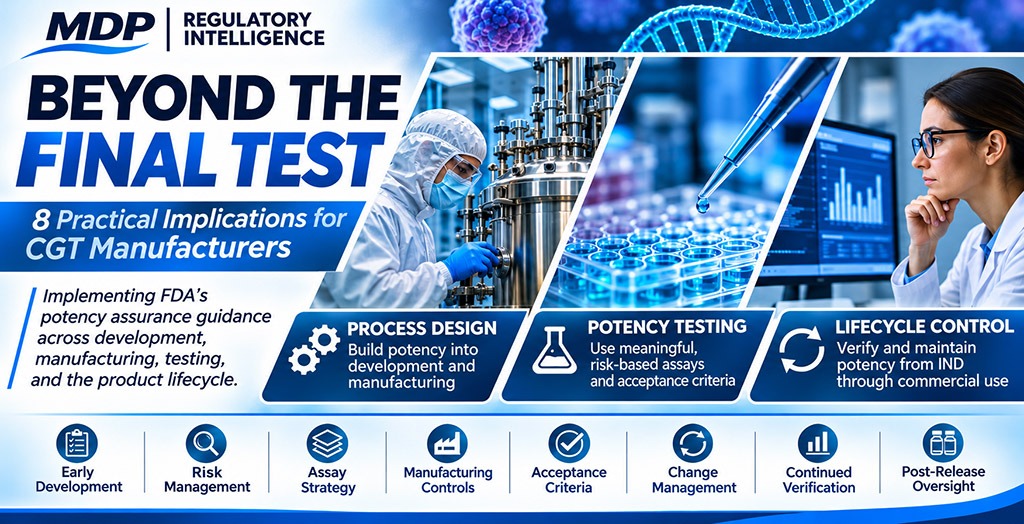
FDA’s November 2026 final guidance moves beyond potency testing to emphasize a comprehensive, risk-based strategy for assuring product potency throughout development, manufacturing, and patient delivery.
FDA’S final guidance, Potency Assurance for Cellular and Gene Therapy Products, replaced its 2011 guidance on potency testing. The guidance introduces a broader approach to ensuring that cellular and gene therapy (CGT) products consistently possess the biological activity needed to achieve their intended therapeutic effect.
For manufacturers, the central message is that potency cannot be assured through final product testing alone. It requires an integrated strategy involving product development, manufacturing controls, analytical testing, quality risk management, and continued process verification.
Eight practical implications manufacturers should consider
1. Potency Assurance Should Begin Early in Development
FDA recommends that manufacturers begin identifying potency-related critical quality attributes (CQAs), evaluating risks, and establishing an initial Potency Assurance Strategy before clinical investigations. These activities should evolve as product knowledge and manufacturing experience increase.
For early investigational new drug (IND) submissions, FDA recommends describing the product’s mechanism of action, preliminary CQAs, potency-related risks, and proposed controls.
By later stages of clinical development, manufacturers should have a more comprehensive strategy supported by appropriate potency assays and acceptance criteria.
Manufacturer consideration. Potency assurance should be incorporated into development planning rather than postponed until preparation of a biologics license application (BLA).
2. Potency Testing Must Address Meaningful Product Attributes
Cell and gene therapies often involve complex biological mechanisms that cannot be adequately characterized through a single analytical measurement. FDA recommends identifying potency-related CQAs based on the product’s mechanism of action, intended therapeutic effect, and available scientific evidence.
Depending on the product, a combination of biological and physicochemical assays may be appropriate.
Importantly, FDA recognizes that a potency bioassay does not necessarily need to reproduce the product’s entire mechanism of action. Instead, it should measure a relevant biological activity and help control an identified risk to potency.
Manufacturer consideration. Evaluate whether existing potency assays measure attributes that meaningfully contribute to potency assurance, rather than simply generating acceptable test results.
3. Manufacturing Variability Must Be Understood and Controlled
Variability in starting materials and manufacturing processes can significantly affect the potency of cellular and gene therapy products. This is especially important for patient-specific therapies, where starting materials may differ because of individual patient characteristics, disease conditions, or previous treatments.
FDA recommends identifying critical process parameters (CPPs) that influence potency-related CQAs and establishing appropriate controls.
The guidance also discusses adaptive manufacturing approaches, such as adjusting cell expansion steps to accommodate differences in starting material characteristics.
Manufacturer consideration. Risk assessments should address how material variability and manufacturing conditions may affect potency, and whether existing controls adequately reduce those risks.
4. Potency Assurance Extends Beyond Manufacturing
A product that meets potency specifications at release may still experience changes before administration. FDA recommends evaluating risks associated with storage, shipping, handling, thawing, product preparation, and delivery devices.
For example, cell viability may be affected by handling conditions, while certain gene therapy products may experience degradation, aggregation, or adsorption to surfaces. These risks are particularly important for therapies requiring specialized transportation or preparation immediately before administration.
Manufacturer consideration. Potency risk assessments should extend through the product’s intended conditions of distribution, preparation, and clinical use.
5. Short Shelf Lives Require Alternative Approaches
Some cellular therapies have shelf lives too short to complete conventional biological potency assays before the product must be administered. FDA recognizes this challenge and discusses approaches that combine appropriate physicochemical release testing, manufacturing process controls, in-process testing, and post-release biological assays.
Post-release testing can provide additional evidence that the manufacturing process consistently produces potent products, even when results are unavailable before administration.
However, this flexibility does not eliminate the need to adequately assure potency.
Manufacturer consideration. Manufacturers of short-lived products should establish scientifically justified release strategies supported by process understanding, risk assessment, and continued verification.
6. Potency Acceptance Criteria Must Support Meaningful Decisions
FDA emphasizes that potency assays must have appropriate quantitative acceptance criteria. Simply reporting a test result without establishing whether it represents acceptable potency does not provide an adequate basis for release decisions.
Acceptance criteria should be capable of identifying sub-potent lots. Where excessive biological activity could introduce safety concerns, appropriate upper limits may also be necessary.
For licensed products, potency specifications should support consistency with the product characteristics demonstrated during clinical development.
Manufacturer consideration. Review potency specifications to ensure they provide meaningful acceptance or rejection decisions and are supported by appropriate scientific evidence.
7. Assay Changes and Technology Transfers Require Careful Evaluation
Potency assays may evolve as analytical technologies improve, manufacturing processes change, or testing activities move between laboratories. FDA recommends evaluating the potential effects of assay changes on measurement performance and potency assurance.
Depending on the risks involved, changes may require additional qualification, validation, or comparability studies. For laboratory transfers, manufacturers should establish evidence that the receiving laboratory can produce reliable and comparable results.
Manufacturer consideration. Analytical change control should consider not only whether a revised method performs adequately, but also whether it maintains the ability to detect meaningful changes in product potency.
8. Potency Assurance Continues After Product Release
FDA recommends continued process verification to confirm that licensed manufacturing processes remain capable of consistently producing potent products. Manufacturers should routinely evaluate product and process data to identify trends, emerging variability, and opportunities to strengthen controls.
The guidance also addresses post-release potency testing for certain short-lived products. If a licensed biological product is distributed and subsequently found to have unacceptable potency, applicable biological product deviation reporting requirements may be triggered.
Manufacturer consideration. Potency assurance should remain connected to ongoing process monitoring, deviation investigations, change control, and corrective and preventive action activities throughout commercial manufacturing.
Integrating Potency Assurance into the Quality System
One important aspect of the guidance is FDA’s recommendation that potency assurance be integrated into existing quality risk management activities. Manufacturers do not need to establish a separate quality system dedicated exclusively to potency.
Instead, the Potency Assurance Strategy should connect established quality and manufacturing processes, including material controls, process development, risk management, analytical method validation, manufacturing change control, and continued process verification.
This integrated approach is particularly important for products with complex manufacturing processes, variable biological starting materials, or limited opportunities for conventional final product testing.
Conclusion
FDA’s final guidance reinforces an important principle, that potency is not simply a characteristic measured at the end of manufacturing. It is a product quality attribute that must be understood, controlled, and maintained throughout the therapy’s lifecycle.
For cellular and gene therapy manufacturers, an effective Potency Assurance Strategy provides a framework for connecting scientific understanding, manufacturing performance, analytical evidence, and quality risk management.
The guidance does not establish a new set of binding requirements. Rather, it explains FDA’s current recommendations for meeting existing potency-related regulatory obligations.
Manufacturers that evaluate these recommendations against their current development and quality systems can identify opportunities to strengthen potency assurance while supporting consistent product quality and patient safety.
When Political Priorities and FDA Science Collide
HHS proposes expanding access to six unapproved peptides despite objections from FDA scientists. This raises questions about regulatory oversight, patient safety, and the distinction between enforcement discretion and drug approval.The Trump administration is moving...
What to Know about FDA’s Revised Peptide Guidance
What Manufacturers Need to Know Seventeen revised draft product-specific guidance documents reflect FDA's evolving scientific and regulatory approach to generic peptide drug development. On July 28, 2026, the U.S. Food and Drug Administration (FDA) published 17...
The Regulatory Dilemma of Experimental Peptides
As demand for experimental peptides grows, a fundamental question confronts federal regulators. Can access to unapproved drug products expand without compromising the standards intended to protect patients? The growing popularity of experimental peptides such as...
FDA Moves Toward New Peptide Compounding Policy
FDA Moves Toward New Peptide Compounding PolicyAgency submits proposed policy change for White House review as HHS signals support for expanded access to experimental peptides Nearly three months after an FDA advisory committee recommended adding six experimental...