A Regulatory Solution in Search of a Problem
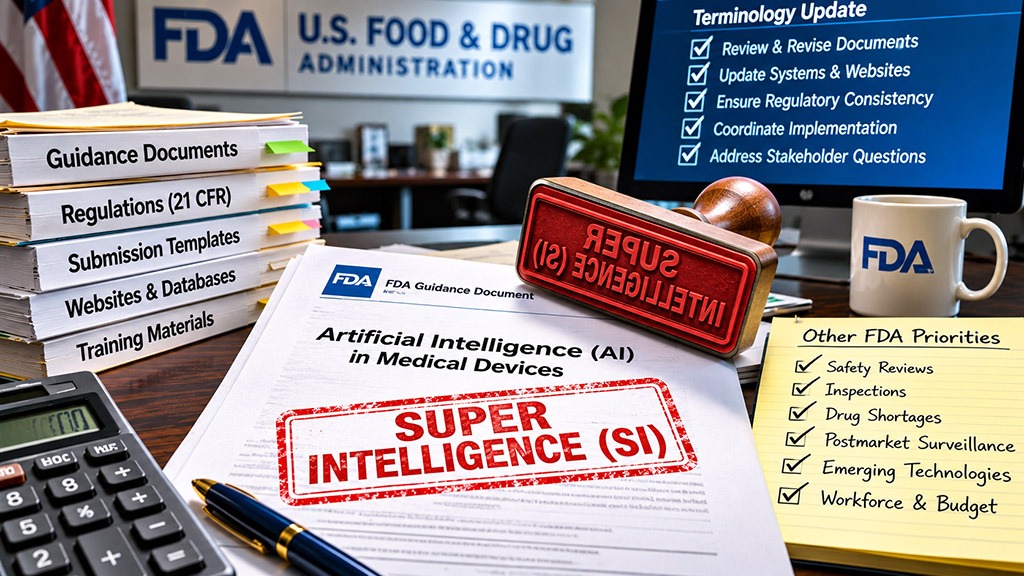
FDA’s implementation of a presidential terminology mandate raises questions about scientific accuracy, regulatory consistency, and the responsible use of limited public health resources.
Beginning November 16, 2026, the U.S. Food and Drug Administration (FDA) will replace the terms Artificial Intelligence (AI) with Super Intelligence (SI) in newly issued public-facing communications and documents, pursuant to Executive Order 14434, signed by President Donald Trump on September 29, 2026.
The change is already visible across FDA’s website, where visitors are greeted with an announcement announcing the transition to the new terminology.
The administration maintains that the new designation better reflects the extraordinary capabilities and potential of emerging technologies. However, from a scientific and regulatory perspective, the mandate raises a fundamental question: What problem does this terminology change solve?
For an agency responsible for protecting public health, operating with limited resources, and confronting increasingly complex regulatory challenges, the answer is far from apparent.
Artificial Intelligence and Superintelligence Are Not the Same Thing
Artificial intelligence is a broad scientific and technological discipline encompassing systems designed to perform tasks that ordinarily require aspects of human intelligence. These include machine learning, pattern recognition, natural language processing, predictive analytics, computer vision, and automated decision-making. Artificial superintelligence, by contrast, generally refers to a hypothetical form of intelligence that substantially exceeds human cognitive capabilities across a broad range of domains.
The distinction is significant. A medical device that uses machine learning to identify suspicious pulmonary nodules is not superintelligent. Neither is an algorithm designed to detect diabetic retinopathy, predict cardiac arrhythmias, or identify potential medication interactions.
These technologies may outperform humans in narrowly defined tasks, but that does not make them superintelligent systems. Even today’s sophisticated generative AI systems have significant limitations involving accuracy, reliability, reasoning, and contextual understanding.
Ironically, Executive Order 14434 initially defines Super Intelligence using the existing statutory definition of artificial intelligence under 15 U.S.C. § 9401(3). In other words, the terminology has changed, but the underlying legal definition has not. The mandate does not establish that existing AI technologies have achieved superintelligence. It simply directs federal agencies to call them something different.
The Administrative Burden of Renaming a Technology
For FDA, implementing this mandate involves considerably more than changing a banner on its website. Artificial intelligence terminology is embedded throughout the agency’s regulatory infrastructure, including guidance documents, scientific publications, regulatory policies, submission templates, databases, educational materials, and communications with regulated industries.
FDA has indicated that existing documents will remain effective as written and that terminology changes will generally be incorporated during scheduled substantive revisions and routine maintenance activities.
Nevertheless, implementing the transition will involve work across multiple areas, including the review, revision, and republishing of affected guidance documents as they undergo substantive revision. Then there will be changes to digital communication such as websites, databases, search functions, and electronic submission systems are updated.
On the administrative side, FDA will need to revise agency forms, templates, educational resources, and training materials. And reconcile the terminology change across FDA centers, offices, and regulatory programs. All while maintaining consistency with existing statutory and regulatory language.
And following those updates, FDA will need to communicate the changes to manufacturers, healthcare professionals, researchers, and international regulatory authorities who still use the term artificial intelligence. A global search-and-replace operation cannot adequately address these issues. Scientific terminology, legal references, recognized consensus standards, document titles, and historical regulatory records require careful consideration.
FDA must also preserve the ability of stakeholders to locate and understand existing information using the terminology that has been established throughout decades of scientific research and regulatory practice. The agency’s decision to incorporate these changes into normal maintenance cycles is a reasonable effort to minimize disruption but will cause a growing mismatch of terms between legacy documentation and the changed versions. And it does not, however, eliminate the additional administrative burden.
What About Existing Regulations?
The executive order does not currently require FDA to amend previously issued regulations, and FDA has confirmed that existing regulations and guidance documents remain effective as written.
However, the executive order also directs the Assistant to the President for Science and Technology to develop proposed legislative language establishing a federal definition of Super Intelligence and identifying potential amendments to existing statutory references to artificial intelligence.
Should these proposals ultimately result in statutory changes, additional regulatory revisions could become necessary. Depending on their nature, such revisions could involve legal review, rulemaking, Federal Register publication, public comment, and corresponding updates to regulatory guidance and implementation materials.
What begins as a terminology change could therefore evolve into a considerably more extensive regulatory undertaking, all at the taxpayers’ expense.
An Agency Already Facing Resource Constraints
The timing of this mandate is particularly concerning. In February 2026, the U.S. Government Accountability Office (GAO) reported that FDA continues to face challenges recruiting, retaining, and training personnel. These challenges have affected the agency’s ability to conduct inspections and fulfill important oversight responsibilities.
FDA has also experienced substantial workforce reductions, followed by efforts to rebuild its scientific and regulatory staffing capacity. Meanwhile, the administration’s FY 2027 budget request proposes approximately $3.306 billion in FDA appropriated budget authority, compared with $3.354 billion enacted for FY 2026 – a proposed reduction of approximately $47.8 million, separate from industry user fee funding.
These resource constraints come at a time when FDA must address numerous public health and regulatory priorities. The agency must also continue developing meaningful regulatory frameworks for artificial intelligence itself, addressing issues such as algorithmic bias, clinical performance, cybersecurity, data integrity, transparency, and lifecycle management.
These are substantive scientific and regulatory challenges that directly affect patient safety. And renaming the technology does not resolve any of them.
The Cost of the Mandate
There is no publicly identified comprehensive estimate of what implementing the terminology change will cost FDA. However, the absence of a dedicated budget allocation does not mean that implementation is without cost.
Staff time devoted to reviewing terminology, revising documents, updating information systems, coordinating implementation, and addressing stakeholder questions represents resources that could otherwise support the agency’s public health mission. Even when incorporated into scheduled maintenance activities, these additional tasks consume personnel time and organizational capacity.
For an agency funded through both congressional appropriations and industry user fees, responsible resource allocation is not simply an administrative preference. It is an obligation to taxpayers, regulated industries, and the patients who depend on effective regulatory oversight.
Implications for International Regulatory Harmonization
The medical device and pharmaceutical industries operate within an increasingly interconnected global regulatory environment.
FDA has worked extensively with international regulatory authorities, including Health Canada, the United Kingdom’s Medicines and Healthcare products Regulatory Agency, and members of the International Medical Device Regulators Forum, to establish common approaches to artificial intelligence and machine learning-enabled medical technologies.
International standards organizations, scientific researchers, regulatory authorities, and manufacturers have developed an extensive body of technical terminology to support these efforts. The unilateral adoption of Super Intelligence as a replacement for artificial intelligence introduces an unnecessary inconsistency into that environment.
Manufacturers may now encounter different terminology in FDA communications, international standards, European regulatory requirements, scientific publications, and their own technical documentation, even when these materials describe identical technologies.
FDA has appropriately clarified that manufacturers, sponsors, and applicants are not required to adopt the new terminology. Nevertheless, the change creates another layer of terminology reconciliation for organizations already navigating complex international regulatory requirements.
Scientific Precision Should Remain a Regulatory Priority
We support the responsible development and application of artificial intelligence in medical devices, pharmaceutical development, manufacturing, regulatory science, and healthcare. These technologies offer extraordinary opportunities to improve patient outcomes, accelerate innovation, and enhance regulatory effectiveness.
But realizing those opportunities requires scientific precision, evidence-based decision-making, and a clear understanding of technological capabilities and limitations. Characterizing all artificial intelligence technologies as super intelligence risks obscuring those distinctions rather than improving them.
The concern is not whether FDA should embrace emerging technologies. It should. The concern is whether a politically directed change in scientific terminology represents a meaningful contribution to that objective.
A Question of Priorities
FDA’s responsibility is to protect and promote public health. Its effectiveness depends on the expertise of its personnel, the quality of its scientific assessments, the integrity of its regulatory decisions, and the efficient use of its resources.
At a time when the agency is rebuilding its workforce and confronting significant regulatory challenges, the administration should be able to demonstrate a tangible public benefit before directing resources toward an extensive terminology transition.
What measurable improvement in patient safety, regulatory efficiency, scientific understanding, or technological innovation will result from replacing artificial intelligence with Super Intelligence? Until that question can be answered, the mandate appears to represent an administrative solution to a problem that has not been demonstrated to exist.
Artificial intelligence does not become more intelligent because the government changes its name. And FDA does not become a more effective regulatory agency by being required to do so.
Where Was the Stakeholder Consultation?
A departure from established regulatory practices
One of the distinguishing characteristics of FDA’s regulatory framework is its commitment to transparency, scientific evaluation, and stakeholder participation.
Under the Administrative Procedure Act (5 U.S.C. § 553), substantive regulatory changes generally require public notice and an opportunity for comment. FDA’s Good Guidance Practices (21 CFR § 10.115) similarly establish procedures for stakeholder participation in the development of significant regulatory guidance.
These processes serve an important purpose. They allow scientists, healthcare professionals, manufacturers, professional associations, and other stakeholders to evaluate proposed changes, identify unintended consequences, and contribute to informed regulatory decision-making.
The presidential mandate replacing Artificial Intelligence with Super Intelligence does not appear to have undergone a comparable public consultation process. Although the executive order was published in the Federal Register, publication of an executive order is not equivalent to notice-and-comment rulemaking.
Because the immediate initiative concerns agency terminology rather than substantive regulatory requirements, formal notice-and-comment procedures may not be legally required. However, the absence of a legal requirement does not diminish the potential value of stakeholder consultation.
Several questions remain unanswered
- What scientific evidence supports the terminology change?
- Were scientific and engineering professional organizations consulted?
- Were international regulatory partners given an opportunity to evaluate the implications?
- Was an economic or regulatory impact assessment conducted?
- What measurable public benefit is expected?
Perhaps more concerning, Section 3(b) of the executive order directs the development of proposed legislative language that could modify or supersede the existing statutory definition of artificial intelligence. The initiative could therefore extend well beyond an administrative terminology change.
There is a considerable irony in this approach. FDA routinely expects regulated manufacturers to justify proposed changes, assess their potential risks, evaluate unintended consequences, and document the rationale for their decisions. These expectations reflect sound scientific, engineering, and quality management principles.
Should the federal government not apply comparable principles when directing changes to the scientific and regulatory infrastructure itself? The issue is not simply whether the administration has the authority to mandate a terminology change. It is whether the process reflects the standards of transparency, scientific rigor, and evidence-based decision-making that FDA expects of the industries it regulates.
EU MDR Compliance Consulting Services
Medical Devices and Pharma offers comprehensive services to help your business meet the stringent requirements of the EU Medical Device Regulation (MDR). Our expertise ensures that your products are compliant, safe, and ready for the European market.At Medical Devices...
Extensions for EU MDR and IVDR Implementation
Initial EU MDR and IVDR transition periods extended In 2023, the European Union granted an extension for the implementation of the Medical Device Regulation (MDR) and the In Vitro Diagnostic Medical Device Regulation (IVDR) due to various challenges faced by...
Implementation of the EU MDR and IVDR
A Significant EU Regulatory System Overhaul The implementation of the European Union's Medical Device Regulation (MDR) and In Vitro Diagnostic Medical Device Regulation (IVDR) represents a significant overhaul of the regulatory framework governing medical devices and...
FDA Issues Warning on Counterfeit Botox Products
Real Botox PackagingReal Botox Cosmetic PackagingReal Botox PackagingCounterfeit Botox Products The U.S. Food and Drug Administration (FDA) has issued a critical alert concerning the presence of counterfeit Botox products in various states, posing severe risks to...
FDA Approves XACT Carotid Stent System
A Breakthrough for Stroke Prevention Abbott Vascular Inc. has received FDA approval for its groundbreaking XACT Carotid Stent System, a significant advancement in stroke prevention technology. Approved on February 7, 2024, this innovative system offers new hope for...
FDA’s Orphan Drug Program
Expedite Development of New Orphan Drugs The FDA's Orphan Drug Program is designed to encourage the development of drugs and biologics for the treatment, diagnosis, or prevention of rare diseases or conditions, often referred to as orphan diseases. Here are the key...
Health Alert Regarding Rare Pregnancy Complication
FDA Safety Communication In a recent health safety alert, the U.S. Food and Drug Administration (FDA) has cautioned healthcare professionals about the rare risk of intrahepatic cholestasis of pregnancy (ICP) associated with the use of thiopurines, including...
Risks with Exactech Equinoxe Shoulder System
FDA Safety Communication April 19 Update: Exactech has initiated a recall to remove Equinoxe Shoulder System devices packaged in the defective bags from facilities’ unused inventory. To see if your device is affected by the recall, visit Exactech’s Recall...
FDA – Do Not Use Non-piercing Devices to Measure Blood Glucose
FDA Safety Communication On February 21, 2024 the U.S. Food and Drug Administration (FDA) issued a safety communication regarding the use of smartwatches or smart rings that claim to measure blood glucose levels without the need for skin piercing. Its cautionary...
Urgent Recall Notice for ARROW QuickFlash Catheterization Kits
Urgent Recall Notice for ARROW QuickFlash Catheterization Kits In February 2024, Teleflex and its subsidiary Arrow International issued an urgent recall notice for the ARROW QuickFlash Radial Artery and Radial Artery/Arterial Line Catheterization Kits. Today, a...