293 Clearances and Two De Novo Grants
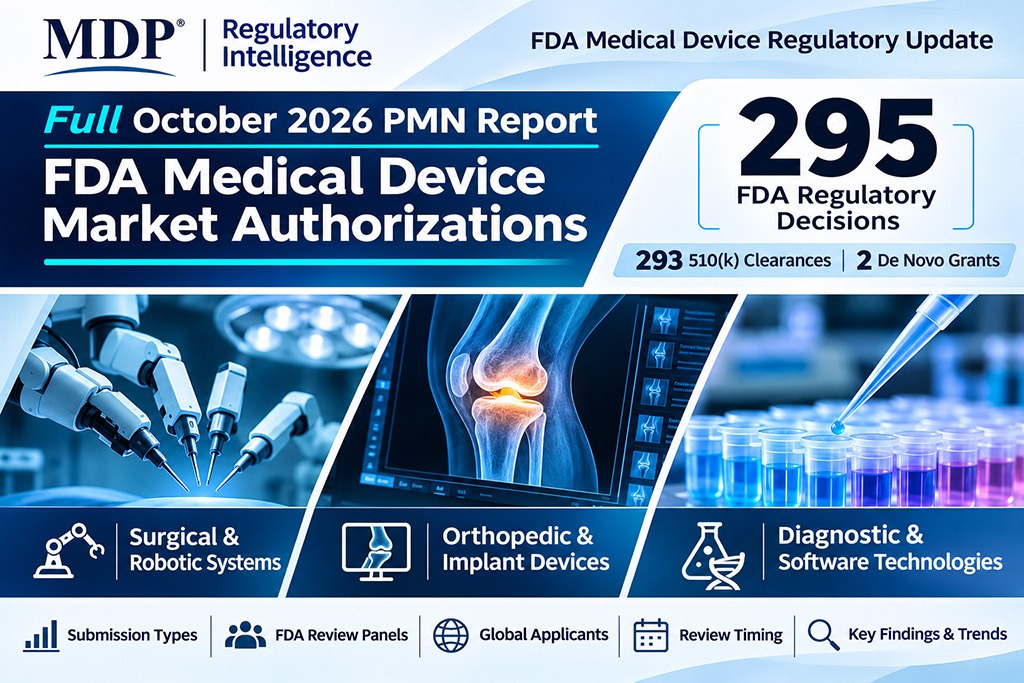
Traditional 510(k) submissions dominate October decisions, while orthopedic, surgical, cardiovascular, and radiology devices lead FDA clearance activity.
The U.S. Food and Drug Administration (FDA) recorded 295 medical device regulatory decisions during October 2026, consisting of 293 premarket notification (510(k)) clearances and two De Novo classification grants, according to an analysis conducted by Medical Devices and Pharma (MDP).
The results provide a snapshot of medical device regulatory activity, including submission pathways, FDA review panels, applicant geography, and the time elapsed between submission receipt and regulatory decision.
MDP’s Full October 2026 PMN Report provides additional analysis of these findings, including noteworthy regulatory patterns, unusual records, and selected medical technologies.
Traditional 510(k) Submissions Account for More Than 80% of Clearances
Of the 293 devices receiving 510(k) clearance, Traditional submissions represented the overwhelming majority.
| Submission type | Clearances | Percentage |
| Traditional 510(k) | 238 | 81.2% |
| Special 510(k) | 50 | 17.1% |
| Dual Track | 3 | 1.0% |
| Abbreviated 510(k) | 2 | 0.7% |
| Total | 293 | 100% |
Two additional decisions involved the De Novo classification pathway, which provides a regulatory route for certain novel devices without a legally marketed predicate.
The relatively small number of Special and Abbreviated submissions illustrates the continued dominance of the Traditional 510(k) pathway among October clearances. However, these figures represent decisions issued during the month, not all submissions received by FDA.
Orthopedic, Surgical, and Cardiovascular Devices Lead Clearance Activity
FDA review-panel assignments reveal where October’s clearance activity was concentrated.
| FDA review panel | Clearances |
| Orthopedic | 42 |
| General & Plastic Surgery | 40 |
| Cardiovascular | 34 |
| Radiology | 33 |
| Neurology | 25 |
| Dental | 24 |
| General Hospital | 19 |
| Microbiology | 17 |
| Gastroenterology/Urology | 13 |
| Physical Medicine | 11 |
| Clinical Chemistry | 10 |
| Obstetrics/Gynecology | 7 |
The six leading review panels accounted for 198 clearances, approximately 67.6% of all October 510(k) decisions.
These figures reflect FDA review-panel assignments rather than a definitive classification of device technologies. Nevertheless, they illustrate the breadth of medical device activity, ranging from orthopedic implants and surgical instruments to cardiovascular technologies, diagnostic imaging, and software.
U.S. and Chinese Applicants Represent Nearly Three-Quarters of Decisions
Applicant geography provides another perspective on the global medical device industry.
Of the 295 decisions, 155 involved applicants with U.S. addresses (52.5%), while 61 involved applicants in China (20.7%). South Korea followed with 18 decisions (6.1%), Germany with nine (3.1%), and the United Kingdom with seven (2.4%). Other countries represented included Israel, Taiwan, France, Switzerland, and Belgium. Together, U.S. and Chinese applicants accounted for 73.2% of October decisions.
Importantly, applicant location does not necessarily indicate where a device is manufactured or the nationality of its ultimate corporate owner.
Submission Timing Reveals Significant Differences
MDP also examined the elapsed calendar time between the dates FDA recorded submissions as received and the dates regulatory decisions were issued.
The median elapsed time for Traditional 510(k) submissions was 140.5 calendar days, compared with 30 days for Special 510(k) submissions. Other categories showed median elapsed times of 180 days for Dual Track submissions, 204 days for Abbreviated submissions, and 267 days for the two De Novo decisions.
These differences are noteworthy but require careful interpretation. The calculations include all calendar days between receipt and decision, including periods when submissions may have been on hold or applicants were responding to additional-information requests. They are not equivalent to FDA review-clock measurements and should not be interpreted as evidence of comparative FDA review performance.
The substantially shorter median observed for Special 510(k) submissions is consistent with the pathway’s more limited scope, although the dataset alone cannot establish why individual decisions took less time.
Robotics, Imaging, and Diagnostic Technologies Highlight Innovation
Several October decisions illustrate the continued development of advanced medical technologies.
Among the notable examples were:
Neocis Yomi S Robotic System (K261321): A robotic dental technology.
CMR Surgical Versius Surgical System, Versius Plus (K261252): A robotic surgical platform.
Virtuoso Surgical Virtuoso Endoscopy System (DEN250054): One of October’s two De Novo grants.
Roche Diagnostics Elecsys HBsAg II quant II RxDx (DEN260027): The month’s other De Novo grant.
The dataset also includes numerous imaging, diagnostic, and software-based medical devices.
These examples suggest several areas worth monitoring, particularly robotic-assisted procedures, diagnostic technologies, and software applications in clinical practice.
However, identifying devices that incorporate artificial intelligence or machine learning requires additional examination of FDA clearance summaries and intended-use information. Device names alone are insufficient to establish the extent of AI-related clearance activity.
Noteworthy Regulatory Patterns and Data Anomalies
MDP identified several additional findings during its analysis.
Third-party reviews remain relatively uncommon. Only four of the 293 510(k) clearances were identified as third-party reviewed, representing approximately 1.4% of the total.
Two unusually short decision intervals deserve closer examination. Submissions K263680 and K263860 each showed only one calendar day between the recorded receipt and decision dates. Both were identified as third-party reviewed. These records warrant verification before conclusions can be drawn about the review process.
One decision was recorded on a Sunday. Submission K253717, involving the Helo Return device from Endovascular Engineering, carried a decision date of October 11, 2026. This may reflect an administrative or reporting convention, but the dataset does not establish the reason.
Manufacturer comparisons require additional normalization. The dataset contained 268 distinct applicant-name entries across 295 decisions. Differences in corporate naming, subsidiaries, and formatting can complicate comparisons of manufacturer activity.
Expedited review information was unavailable. The relevant field was blank throughout the dataset, preventing meaningful conclusions about expedited review activity.
These observations illustrate why regulatory intelligence involves more than simply counting FDA decisions. Understanding the significance of regulatory data requires attention to submission pathways, reporting conventions, data quality, and the limitations of available information.
What FDA’s October PMN Clearance Results Tell Us
October’s FDA decisions demonstrate the continued importance of the Traditional 510(k) pathway, substantial activity across established medical device specialties, and the international scope of the U.S. medical device market.
At the same time, emerging surgical, diagnostic, and software technologies illustrate how innovation continues to develop within existing regulatory pathways and through De Novo classifications.
For manufacturers and regulatory professionals, the findings reinforce the importance of understanding the appropriate submission pathway, preparing complete regulatory documentation, and recognizing how device characteristics and regulatory requirements influence market authorization.
Regulatory intelligence is most valuable when it goes beyond reporting what FDA has done to help industry professionals understand what the information means. MDP’s comprehensive report includes the complete submission-pathway breakdown, review-panel distribution, applicant geography, decision-timing analysis, selected medical technologies, and eight noteworthy regulatory findings and anomalies.
Editor’s Note: The analysis is based on FDA’s October 2026 monthly decision extract. Results reflect decisions recorded during the reporting period and may be subject to subsequent FDA database updates. MDP’s analysis is independent and is not an official FDA publication.
View and Download the FULL October 2026 PMN Report
A Look at the CDRH 2024 Innovation Report
Revolutionizing Medical Device Innovation In a world where medical technology evolves at a rapid pace, ensuring patients have access to cutting-edge, safe, and effective devices is paramount. Yesterday, the Center for Devices and Radiological Health (CDRH) released...
FDA Approves Versatile Antibiotic Zevtera for Three Key Infections
FDA Approves Versatile Antibiotic Zevtera for Three Key Infections The U.S. Food and Drug Administration (FDA) announced today that the fight against bacterial infections has gained a significant boost with the recent approval of Zevtera (ceftobiprole medocaril sodium...
FDA Approves Treatment for Platinum-Resistant Ovarian Cancer
In a significant development for the treatment of platinum-resistant epithelial ovarian, fallopian tube, or primary peritoneal cancer, on March 22, 2024 the Food and Drug Administration (FDA) granted approval for mirvetuximab soravtansine-gynx, marketed as Elahere by...
FDA Approves Thoracic Stent Graft System
FDA Approves RelayPro Thoracic Stent Graft System for Thoracic Aortic Aneurysms and Penetrating Atherosclerotic Ulcers Treatment The United States Food and Drug Administration (FDA) on March 7, 2023 approved the RelayPro Thoracic Stent Graft System, a new medical...
Prodigy Proclaim Spinal Cord Stimulation Systems
Significant advancement for chronic pain treatment On February 15, 2023, the U.S. Food and Drug Administration (FDA) announced the approval of the Prodigy Proclaim and Proclaim XR Spinal Cord Stimulation (SCS) systems. This approval marks a significant step forward in...
FDA Breakthrough Devices Program
FDA Breakthrough Devices Program The U.S. Food and Drug Administration (FDA) has established the Breakthrough Devices Program, a voluntary program that aims to expedite the development, assessment, and review of medical devices that demonstrate potential to provide...
Approvals for FDA Breakthrough Devices
Innovative Devices for Unmet Needs The Food and Drug Administration (FDA) has made a positive decision on the marketing applications of the following products. What sets them apart? They are innovative devices that qualified and participated in FDA's Breakthough...
A Team-based Approach to an Expedited 510(k)
Getting an expedited 510(k) submission So, you have created a new medical device by following your quality system’s design controls to plan the project, define design inputs, test to verify that outputs meet inputs, and validated your production product. Now what?...
FDA Approves Lamzede for Treatment of Alpha-mannosidosis
The U.S. Food and Drug Administration (FDA) on February 17, 2023 announced the approval the first-ever enzyme replacement therapy (ERT) for the treatment of rare alpha-mannosidosis, a genetic disorder that affects an individual's ability to break down complex sugars....
FDA Approves Rukabia for HIV Treatment
The U.S. Food and Drug Administration (FDA) on December 22, 2022 announced the approval of a new HIV drug called Rukobia (fostemsavir) for adults living with HIV who have limited treatment options. This drug is the first in a new class of HIV medications known as...