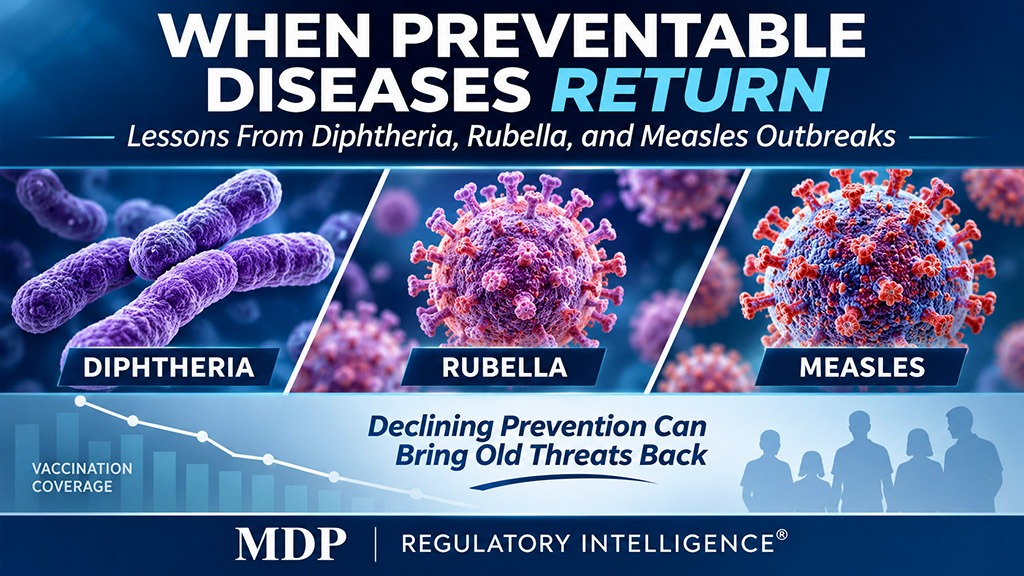
Diseases once brought under control through vaccination have returned with devastating consequences. Historical outbreaks in the former Soviet Union and Japan offer important lessons as the United States confronts its largest measles resurgence in decades.
For generations, diphtheria was one of the most feared childhood diseases. Known historically as the strangling angel, the bacterial infection could produce a thick membrane in the throat, obstructing breathing and sometimes causing death. Survivors could suffer serious complications involving the heart and nervous system.
Widespread vaccination dramatically reduced the disease, transforming what had once been a major public-health threat into a relatively uncommon infection in many countries.
But in the 1990s, diphtheria returned to the former Soviet Union with devastating consequences. The epidemic offers a sobering lesson. When vaccination programs weaken, diseases that appear to have disappeared can return; and the consequences may extend far beyond the people who remain unvaccinated.
The Soviet Union: When a Controlled Disease Returned
By the late 1950s, the Soviet Union had established widespread childhood diphtheria vaccination. For decades, the disease remained largely under control.
During the 1980s, however, vaccination practices began changing. Concerns about vaccine safety contributed to increasingly restrictive recommendations, expanded contraindications, delayed immunizations, and the use of reduced-antigen vaccines in some children. These changes left growing numbers of children inadequately protected. At the same time, many adults lacked sufficient immunity.
Then came the collapse of the Soviet Union in 1991. Economic instability, population movement, disrupted vaccine supplies, and deteriorating public-health infrastructure compounded the problem. An epidemic that had begun in Russia in 1990 spread across the newly independent republics. By 1995, approximately 50,000 diphtheria cases were reported annually. According to the World Health Organization, the epidemic ultimately caused more than 157,000 cases and approximately 5,000 deaths.
The disease had not fundamentally changed. What had changed was the population’s protection against it. Controlling the epidemic required extensive international cooperation and mass vaccination campaigns, including immunization of millions of adults. The experience demonstrated that successful vaccination programs must be maintained, not merely established.
Japan: The Hidden Consequences of Immunization Gaps
Japan experienced a different but equally instructive public health failure. When Japan introduced routine rubella vaccination in 1976, the program initially targeted adolescent girls. The strategy was intended to protect future mothers and prevent congenital rubella syndrome. However, the approach left substantial numbers of boys and men without vaccination. As those generations reached adulthood, gaps in population immunity persisted.
Rubella is often a relatively mild infection in children and adults. During pregnancy, however, infection can have devastating consequences, including miscarriage, stillbirth, and congenital rubella syndrome. Affected infants may experience hearing impairment, vision problems, congenital heart defects, and other serious developmental complications.
In 2013, Japan experienced a major rubella epidemic, with more than 14,000 reported cases. Approximately three-quarters occurred among males, many of them adults. The 2012–2013 epidemic was associated with 45 reported cases of congenital rubella syndrome during 2012–2014.
Japan experienced another substantial rubella resurgence in 2018–2019, again disproportionately affecting adult men. The lesson was not simply that vaccination coverage had declined. Rather, an earlier vaccination strategy had left entire population groups susceptible, creating conditions for outbreaks decades later.
Immunization gaps can remain invisible for years before their consequences become apparent.
The United States: Measles Returns
The United States now faces its own reminder that infectious diseases do not disappear simply because they have become uncommon. Measles was declared eliminated from the United States in 2000, a designation meaning that continuous domestic transmission had been interrupted. Imported cases could still occur, but sustained spread was no longer established. That achievement followed decades of vaccination efforts.
Today, the situation is changing. According to the Centers for Disease Control and Prevention (CDC), the United States reported 5,182 confirmed measles cases as of November 5, 2026, compared with 2,289 during all of 2025. The 2026 total represents the highest annual number of reported U.S. measles cases since 1991. CDC identified 43 new outbreaks during 2026, with approximately 96% of confirmed cases associated with outbreaks.
Meanwhile, national vaccination coverage among kindergarten students declined from 95.2% during the 2019–2020 school year to 92.4% during 2025–2026. The national average also conceals substantial differences among communities, where vaccination coverage can be considerably lower. Measles is exceptionally contagious. In susceptible populations, a single infected individual can expose many others, particularly in schools, healthcare facilities, and other shared environments.
Although many patients recover, measles can cause pneumonia, encephalitis, hospitalization, and death. Rarely, a fatal neurological disorder known as subacute sclerosing panencephalitis can develop years after infection. Infants too young for routine vaccination and people with certain medical conditions may face particular risks.
Three Diseases, One Public-Health Lesson
The circumstances surrounding these outbreaks were not identical. The Soviet diphtheria epidemic involved declining vaccination coverage, inadequate adult immunity, public distrust, and the collapse of essential health infrastructure.
Japan’s rubella epidemics exposed the long-term consequences of vaccination policies that left specific population groups susceptible.
The current U.S. measles resurgence reflects declining vaccination coverage and communities where sufficient immunity has not been maintained.
Yet the underlying principle is remarkably consistent. Infectious diseases can return when population immunity is insufficient to prevent sustained transmission. The consequences may not become apparent immediately. Vaccination gaps can accumulate gradually, sometimes over decades, before an imported infection or local outbreak exposes the vulnerability.
And the risks are not confined to individuals who decline vaccination. Disease transmission can threaten newborns, pregnant women, immunocompromised individuals, and others who depend partly on community protection.
The Regulatory and Public-Health Challenge
Vaccination policy involves more than determining whether a vaccine is safe and effective. The FDA evaluates vaccines for safety, effectiveness, and manufacturing quality before approval.
The CDC develops vaccination recommendations and monitors infectious disease trends. State and local authorities establish and administer many school vaccination requirements and public-health programs. Maintaining disease control also depends on reliable vaccine supplies, accessible healthcare, accurate surveillance, public confidence, and consistent implementation of immunization programs. Changes in vaccination recommendations or requirements therefore deserve careful consideration of their potential long-term consequences.
The historical evidence does not mean that every policy change will produce an epidemic. It does demonstrate that reducing population immunity can have consequences that become apparent only after years of accumulating susceptibility.
Prevention Is Easy to Overlook When It Works
Perhaps the greatest challenge in public health is that successful prevention often becomes invisible. When vaccination programs work, outbreaks become rare. Hospitalizations decline. Deaths are prevented. Eventually, generations grow up without witnessing the diseases that earlier generations feared.
That success can create a misleading impression that the threat no longer exists. The former Soviet Union learned otherwise when diphtheria returned. Japan experienced the consequences when rubella spread through susceptible adults and affected unborn children.
And the United States is now confronting a measles resurgence that challenges one of its most significant public-health achievements.
The absence of disease is not proof that prevention is unnecessary. Often, it is evidence that prevention is working. The question facing public-health policymakers is whether those protections will be sustained before another generation learns their value through preventable illness and loss.
The Wolverine Peptide Stack: What We Know
Promoted for faster healing and injury recovery, two experimental peptides are attracting growing consumer interest despite limited human clinical evidence and unresolved safety questions.The promise sounds almost too good to be true: faster recovery from injuries,...
Hims & Hers Moves Into Selling Unapproved Peptides
Telehealth company's planned expansion illustrates how quickly commercial markets are responding to changes in federal oversight of experimental therapies.Hims & Hers Health plans to begin offering new wellness treatments in November, including an unapproved...
When Political Priorities and FDA Science Collide
HHS proposes expanding access to six unapproved peptides despite objections from FDA scientists. This raises questions about regulatory oversight, patient safety, and the distinction between enforcement discretion and drug approval.The Trump administration is moving...
What to Know about FDA’s Revised Peptide Guidance
What Manufacturers Need to Know Seventeen revised draft product-specific guidance documents reflect FDA's evolving scientific and regulatory approach to generic peptide drug development. On July 28, 2026, the U.S. Food and Drug Administration (FDA) published 17...
The Regulatory Dilemma of Experimental Peptides
As demand for experimental peptides grows, a fundamental question confronts federal regulators. Can access to unapproved drug products expand without compromising the standards intended to protect patients? The growing popularity of experimental peptides such as...
FDA Moves Toward New Peptide Compounding Policy
FDA Moves Toward New Peptide Compounding PolicyAgency submits proposed policy change for White House review as HHS signals support for expanded access to experimental peptides Nearly three months after an FDA advisory committee recommended adding six experimental...