
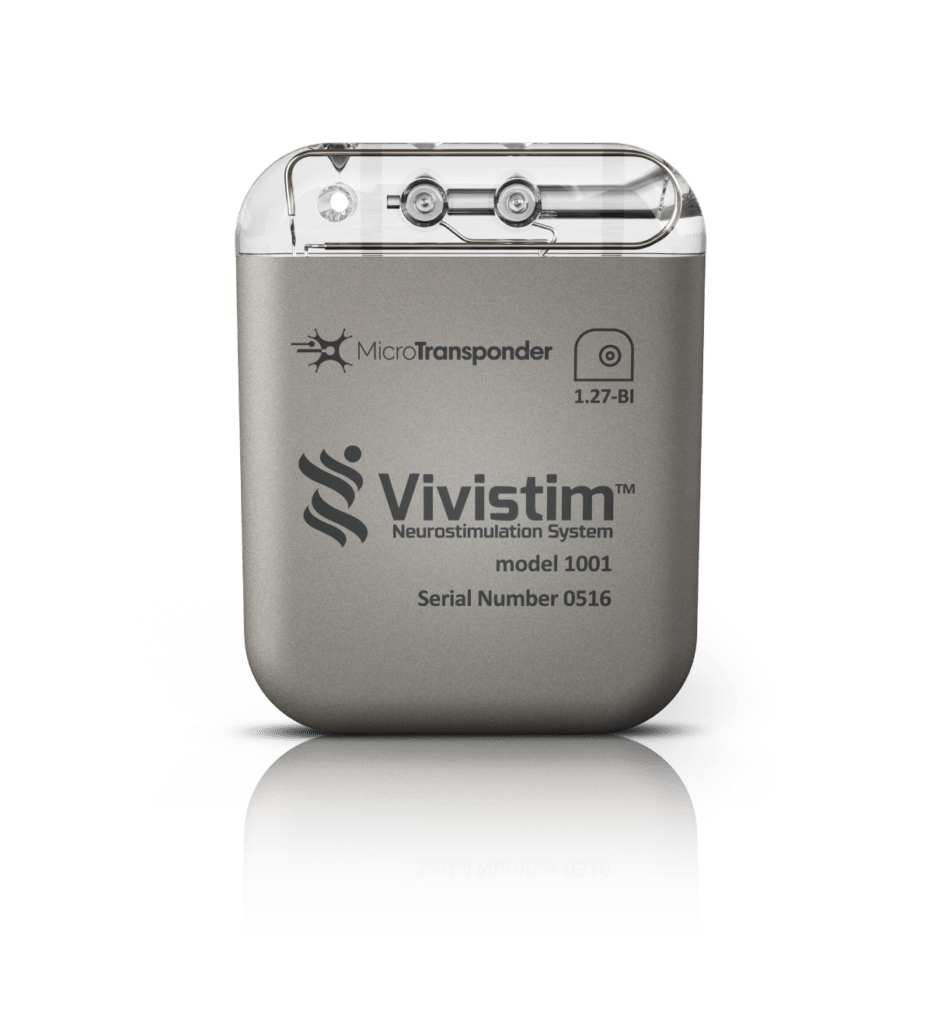
Vivistim implantable vagus nerve stimulator. Source: Vivistim.com.
FDA-Approved Vagus Nerve Stimulation Device Opens a New Pathway in Stroke Recovery
A company behind one of the world’s most closely watched neurorehabilitation technologies is preparing for a major new phase of growth.
According to a recent report from MD+DI Online, Mobia Medical, the maker of the Vivistim® Paired VNS™ System, has gone public to raise capital as it expands the commercialization of its stroke recovery technology. The company reportedly priced its public offering at approximately 10 million shares at $15 per share, seeking roughly $150 million in gross proceeds to support broader adoption of the device and therapy platform.
The story is notable not only from a business perspective, but also because Vivistim represents one of the more innovative FDA-approved neurostimulation therapies to emerge in recent years. Unlike traditional rehabilitation-only approaches, Vivistim combines vagus nerve stimulation (VNS) with structured rehabilitation therapy to improve motor recovery after chronic ischemic stroke.
And importantly, this is not an experimental wellness technology or early-stage concept device. Vivistim is a fully FDA-approved Premarket Approval (PMA) device supported by clinical evidence and granted Breakthrough Device designation by FDA.
Regulatory Snapshot
Device: Vivistim® Paired VNS™ System (Mobia Medical)
Indication: Chronic ischemic stroke patients with moderate to severe upper-extremity motor deficits
Technology: Implantable vagus nerve stimulation (VNS) paired with rehabilitation therapy
Regulatory Pathway: Premarket Approval (PMA)
Breakthrough Designation: FDA Breakthrough Device designation granted prior to PMA approval
FDA Approval: Approved August 27, 2021
What Is Vivistim?
The Vivistim® Paired VNS™ System is an implantable neurostimulation system designed to stimulate the vagus nerve during rehabilitation exercises in stroke patients with moderate to severe upper-extremity impairment.
FDA describes the device as “intended to be used to stimulate the vagus nerve during rehabilitation therapy in order to reduce upper extremity motor deficits and improve motor function in chronic ischemic stroke patients with moderate to severe arm impairment.”
The system includes an implantable pulse generator (IPG), an implanted stimulation lead attached to the left vagus nerve, programming software, and a wireless communication system.
During rehabilitation therapy, stimulation is paired with specific rehabilitation movements. The concept is based on the idea that vagus nerve stimulation may help reinforce neuroplasticity and motor relearning during rehabilitation exercises.
Patients may also continue portions of therapy at home using a magnet-activated stimulation system paired with prescribed exercises.
A Different Approach to Stroke Recovery
Stroke rehabilitation has long faced a difficult reality, that many patients plateau after traditional therapy and are left with chronic upper-extremity weakness or impaired arm function. FDA’s Summary of Safety and Effectiveness Data (SSED) acknowledges that there are no medications approved for chronic stroke recovery and few treatments other than rehabilitation for post-stroke upper limb deficits.
That unmet need supports FDA decision to grant Vivistim a Breakthrough Device designation in 2021. FDA’s other reasons for the decision were that the device addresses an irreversibly debilitating condition, and it offers the potential for a significant clinically meaningful advantage over existing standard-of-care rehabilitation.
Clinical Evidence
The FDA approval was supported by multiple clinical studies, including the pivotal VNS-REHAB study involving 108 implanted subjects across 19 investigational sites.
The study evaluated whether pairing vagus nerve stimulation with rehabilitation movements could improve upper-extremity motor function compared with rehabilitation therapy alone.
According to FDA’s review, the study achieved both primary and secondary endpoints, improvements were considered clinically meaningful, and outcomes were significantly greater than control rehabilitation therapy alone.
FDA reported that Fugl-Meyer Assessment upper-extremity scores improved more in the VNS group than controls, Wolf Motor Function Test scores also favored the VNS group, and quality-of-life measures demonstrated additional benefit.
The SSED concluded that “VNS combined with rehabilitation provides a safe and effective treatment for improving motor function across multiple domains of impairment, function, and quality of life measures in individuals with moderate to severe arm weakness after chronic stroke.”
Implantation and Safety Considerations
Vivistim is an implanted Class III medical device and therefore involves surgical implantation and has associated risks.
The stimulation lead is attached to the left vagus nerve in the neck and tunneled to an implanted pulse generator located in the chest region.
Potential risks described in FDA documentation include infection, hoarseness, swallowing difficulty, discomfort from stimulation, nerve trauma, implant-site complications, and possible device revision procedures.
However, FDA reported that adverse events in the pivotal trial were generally mild or moderate, with only one serious adverse event related to surgery, which resolved without long-term effects.
Neurostimulation Continues to Expand Beyond Traditional Applications
Vagus nerve stimulation itself is not entirely new technology. Implanted VNS systems have previously been used for treatment of epilepsy, treatment-resistant depression, and other neurological conditions.
But Vivistim represents an important expansion of neurostimulation into rehabilitation medicine and post-stroke functional recovery. That broader trend reflects growing interest in neuroplasticity, brain-computer interfaces, bioelectronic medicine, neuromodulation, and device-assisted rehabilitation.
The ability to combine targeted stimulation with structured therapy may represent a significant shift in how chronic neurological impairment is approached in the future.
Download the Vivistim SSED Information
Download Vivistim Labeling Information
Download the Vivistim FDA Approval Order
Why The Device Matters
Stroke remains one of the leading causes of long-term disability worldwide. Many stroke survivors continue to experience impaired arm and hand function, reduced independence, difficulty with daily activities, and diminished quality of life long after the initial event.
Technologies that can potentially improve rehabilitation outcomes, even modestly, may have substantial impacts for patients, caregivers and rehabilitation systems.
Vivistim is notable because it represents an FDA-approved PMA neurostimulation platform supported by controlled clinical data that targets a major unmet rehabilitation need by using a mechanism grounded in neuroplasticity and functional retraining.
As Mobia Medical expands commercialization efforts following its public offering, Vivistim will likely become an increasingly important device to watch within neurorehabilitation, neuromodulation, and restorative medical technology.
For regulatory professionals, clinicians and industry observers, the device also represents a compelling example of how implantable neurotechnology is moving beyond symptom management and into functional recovery applications.