Abbott’s Amplatzer Paraclose PVL Occluder offers a minimally invasive alternative for patients who develop a significant complication following heart valve replacement surgery.
Heart valve replacement surgery can be lifesaving for patients with damaged or diseased heart valves. But even after a successful procedure, some patients develop a complication that may require additional treatment—or another major operation.
On October 27, 2026, the U.S. Food and Drug Administration (FDA) approved Abbott Medical’s Amplatzer Paraclose PVL Occluder, a device designed to close leaks that develop around surgically implanted replacement heart valves.
According to Abbott, it is the first FDA-approved transcatheter device in the United States specifically designed to treat these leaks.
When a Replacement Heart Valve Develops a Leak
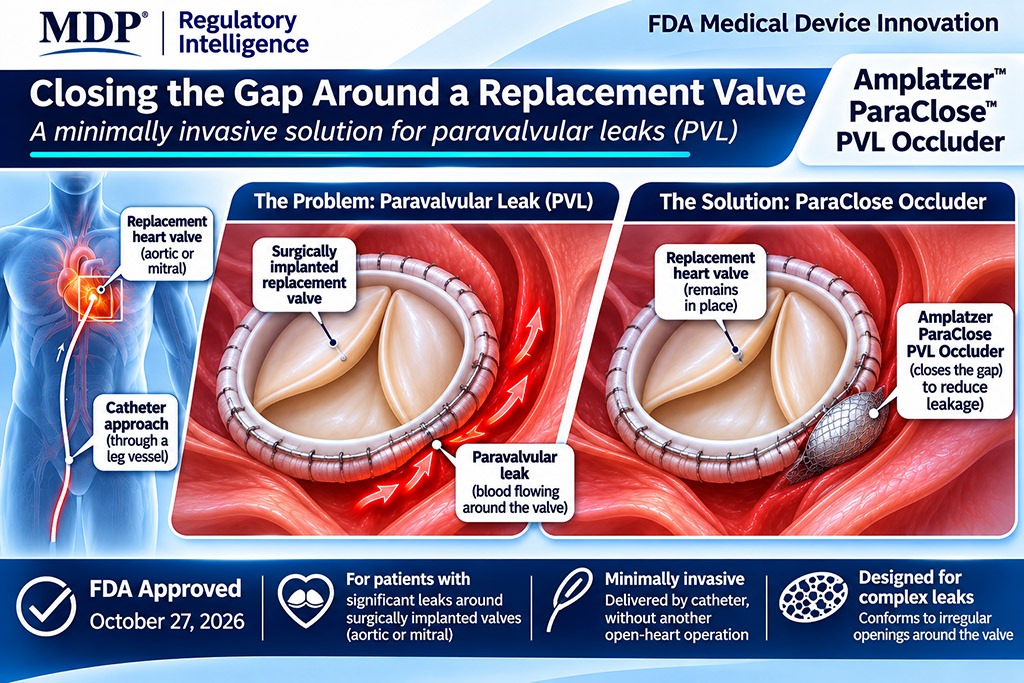
Replacement heart valves are designed to restore normal blood flow through the heart. However, a small gap can sometimes remain or develop between the replacement valve and the surrounding heart tissue. This condition, called a paravalvular leak (PVL), allows blood to flow backward around the replacement valve rather than passing through it normally.
Abbott reports that paravalvular leaks occur in approximately 7% to 17% of mitral valve replacements and 5% to 10% of aortic valve replacements. Not all leaks require treatment, but clinically significant leaks can cause serious complications.
Patients may experience shortness of breath, fatigue, swelling, and other symptoms associated with heart failure. Leaks can also damage circulating red blood cells, potentially causing anemia. For patients who require treatment, another open-heart operation may carry substantial risks, particularly when they have other medical conditions.
Closing the Leak Without Another Open-Heart Operation
The Amplatzer Paraclose PVL Occluder provides a less invasive approach. Rather than reopening the chest, a physician inserts a catheter through a blood vessel in the patient’s leg and guides the device to the affected heart valve.
The occluder is positioned within the gap between the replacement valve and surrounding tissue, where it expands to help stop the abnormal blood flow. Its specialized oblong shape is designed to accommodate the irregular openings that can develop around replacement valves.
FDA approved the device for patients with clinically significant paravalvular leaks associated with surgically implanted aortic or mitral valve prostheses. The device is intended to treat leaks around existing replacement valves, not to replace the valves themselves.
Clinical Evidence Supporting Approval
FDA’s approval was supported by the PARADIGM clinical study, a prospective, multicenter study involving 200 patients. The study evaluated the use of the Amplatzer Paraclose device in patients requiring treatment for paravalvular leaks.
According to Abbott, the results supported the device’s safety and effectiveness as a minimally invasive treatment option. The technology also has an international history. Abbott reports that the device has been available in Europe since 2020 under the name Amplatzer Valvular Plug III.
The October approval establishes a specifically authorized treatment option for this application in the United States.
MDP Regulatory Intelligence Perspective
The Amplatzer Paraclose approval illustrates an important direction in cardiovascular medical device development; expanding minimally invasive treatment options for complications associated with earlier procedures.
Medical device innovation does not always involve replacing an existing treatment. Sometimes it involves developing a safer or less burdensome way to address problems that arise afterward. For patients with clinically significant paravalvular leaks, a catheter-based closure procedure may offer an alternative to repeat open-heart surgery.
From a regulatory perspective, the approval also demonstrates the role of the PMA pathway in evaluating specialized, higher-risk medical devices intended to address significant clinical needs.
The Amplatzer Paraclose PVL Occluder represents an important addition to cardiovascular treatment options, offering physicians a purpose-designed technology for managing a potentially serious complication of heart valve replacement surgery.
FDA Approves First Treatment to Reduce Risk of Acute Pancreatitis
FDA Approves First Treatment Proven to Reduce Acute Pancreatitis Risk in Severe HypertriglyceridemiaAn important example of the distinction between surrogate endpoints and clinical outcomes in drug development The U.S. Food and Drug Administration (FDA) has approved...
One Contaminated Alcohol Pad, Multiple Recalls
A Lesson in Medical Device Supply Chain Quality At first glance, Cardinal Health's recent recall of Webcol™ Alcohol Prep Pads appears straightforward. A commonly used healthcare product was found to be contaminated with Paenibacillus phoenicis, creating a potential...
Early Alert: Windstone Medical Recall for Convenience Kits
FDA Warns of Convenience Kits Containing Recalled Cardinal Health Alcohol Pads The FDA has issued an Early Alert regarding several medical convenience kits distributed by Windstone Medical Packaging, Inc. that contain alcohol prep pads previously recalled by Cardinal...
Webcol Alcohol Prep Pads Recall Due to Microbial Contamination
Cardinal Health Recalls Alcohol Prep Pads Over Infection Risk Concerns Cardinal Health has issued a voluntary nationwide recall of select lots of its Webcol™ Large Alcohol Prep Pads (70% isopropyl alcohol) after testing identified microbial contamination with...
FDA Issues Warning Letter for Modifications to Infant Products
FDA Issues Warning Letter to Happiest Baby Over SNOO Smart Sleeper Modifications and Quality System Deficiencies The U.S. Food and Drug Administration has issued a Warning Letter to Happiest Baby, Inc., manufacturer of the SNOO Smart Sleeper, citing unapproved device...