
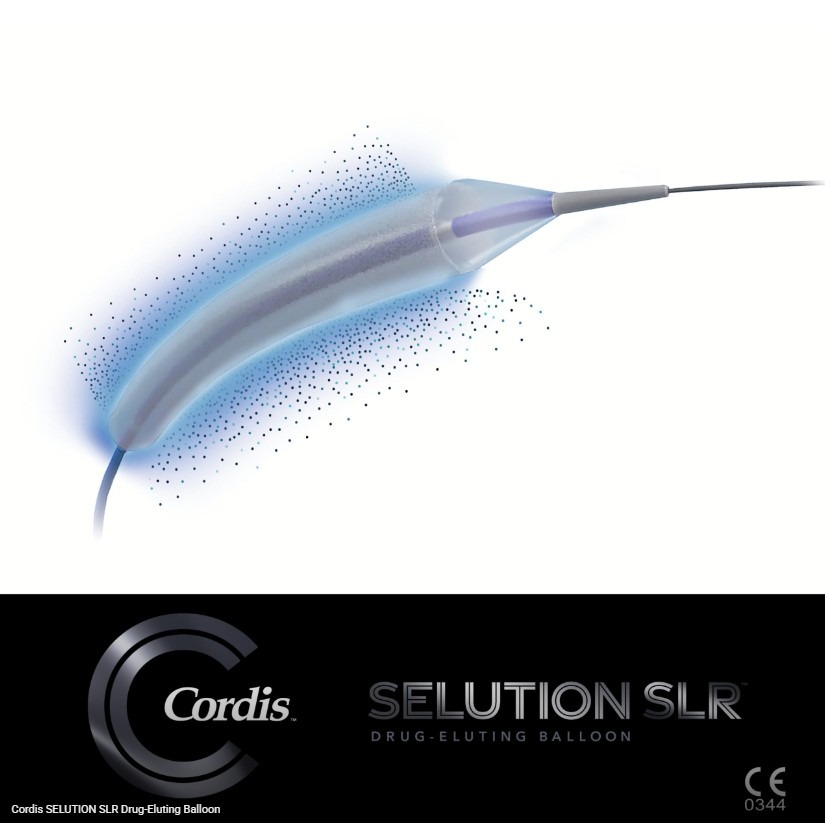
SELUTION SLR Drug-Eluting Balloon. Source: MedAlliance LLC
New PMA approval introduces a sirolimus-eluting balloon treatment for coronary arteries, supported by randomized clinical evidence and ongoing post-approval surveillance.
FDA approved the SELUTION SLR™ 014 PTCA Drug-Eluting Balloon on September 18, 2026, authorizing commercial distribution under the conditions specified in its approval order.
The device received FDA Breakthrough Device designation in February 2019, although the FDA PMA database indicates that expedited review was not granted.
FDA Authorization
| Item | Information |
| Device | SELUTION SLR™ 014 PTCA Drug-Eluting Balloon |
| Manufacturer | MedAlliance LLC |
| Authorization | Original Premarket Approval (PMA) |
| PMA Number | P250041 |
| FDA Approval Date | September 18, 2026 |
| Device Classification | Class III |
| Product Code | OOB |
| FDA Advisory Committee | Cardiovascular |
| Product Type | Drug-device combination product |
| Clinical Study | SELUTION4ISR (NCT04280029) |
Device Overview
The SELUTION SLR is a drug-eluting balloon catheter used to treat coronary in-stent restenosis (ISR), a condition in which an artery becomes narrowed again following the placement of a coronary stent.
During percutaneous coronary intervention (PCI), the balloon is positioned within the narrowed portion of the artery and inflated to restore blood flow. At the same time, it delivers sirolimus, a medication intended to inhibit the tissue growth that can cause the artery to narrow again.
FDA approved the device for use after appropriate vessel preparation in coronary arteries measuring 2.25–4.50 mm in diameter, with lesions no longer than 26 mm.
Unlike the placement of another coronary stent, treatment with a drug-eluting balloon does not leave an additional permanent implant in the artery.
Technology and Innovation
The SELUTION SLR combines conventional balloon angioplasty with a specialized drug-delivery coating designed to provide sustained release of sirolimus.
Its coating incorporates sirolimus within biodegradable polymer microspheres, together with a lipid-based formulation that facilitates drug transfer to the vessel wall during balloon inflation.
The microspheres are designed to regulate the release of sirolimus as the polymer gradually degrades.
This approach offers an alternative to implanting another drug-eluting stent, particularly when additional layers of stent material may be undesirable.
The technology is an example of continued innovation in drug-device combination products, combining mechanical intervention with localized pharmaceutical therapy.
Clinical Evidence
FDA approval was supported by the SELUTION4ISR clinical study, a prospective, multicenter, randomized trial involving 418 patients with coronary in-stent restenosis.
The study compared SELUTION SLR with standard-of-care treatment consisting primarily of drug-eluting stents, with conventional balloon angioplasty also permitted.
The primary endpoint was target lesion failure at 12 months, a composite measure incorporating cardiac death, target-vessel myocardial infarction, and the need for repeat treatment of the target lesion.
The study met its primary endpoint, demonstrating noninferiority to standard-of-care treatment.
| Clinical outcome at 12 months | SELUTION SLR | Standard of care |
| Target lesion failure | 16.2% | 14.5% |
| Target lesion revascularization | 12.7% | 12.4% |
However, a prespecified secondary comparison involving patients with one previous stent layer did not demonstrate noninferiority to treatment with an additional drug-eluting stent. Target lesion failure was 14.2% with SELUTION SLR versus 6.5% in the drug-eluting stent comparison group.
FDA noted limitations in interpreting this secondary comparison because patients receiving the different standard-of-care treatments were not separately randomized.
These findings suggest that patient selection is important, particularly when considering whether an additional stent is clinically appropriate.
Regulatory Significance
Several aspects of the approval are noteworthy for medical device manufacturers and regulatory professionals.
Breakthrough Device designation. FDA granted the device Breakthrough Device designation in 2019, recognizing the potential importance of the technology and its proposed clinical application.
Combination product requirements. The device incorporates both mechanical and pharmaceutical functions, requiring supporting evidence related to device performance, drug delivery, biocompatibility, and product stability.
Post-approval clinical follow-up. FDA required continued monitoring of the 418 patients enrolled in the pivotal SELUTION4ISR study through five years following treatment.
Real-world surveillance. A separate post-approval surveillance analysis will evaluate approximately 3,500 patients treated at U.S. sites, with particular attention to outcomes among women and racial and ethnic groups underrepresented in the pivotal clinical study.
Product stability requirements. The approval includes additional long-term drug stability testing and evaluation of the sirolimus coating. FDA established an approved shelf life of 18 months.
These requirements illustrate how PMA approval can extend beyond the initial authorization decision, with continuing obligations to evaluate long-term clinical performance, product quality, and real-world safety.
Editorial note
One feature of this approval deserves particular attention: the pivotal study met its primary noninferiority endpoint, but a prespecified secondary comparison did not. Both findings are important to understanding the clinical evidence. The FDA’s SSED reports 16.2% versus 14.5% target lesion failure for the primary comparison and 14.2% versus 6.5% for the secondary comparison involving one previous stent layer.
Source: U.S. Food and Drug Administration, PMA P250041. MDP Regulatory Intelligence — September 2026 Market Authorizations.
Regulatory Snapshot
Device: SELUTION SLR™ 014 PTCA Drug-Eluting Balloon
Manufacturer: MedAlliance LLC
Indication: Coronary in-stent restenosis (ISR)
Technology: Sirolimus-eluting balloon with sustained drug delivery
Regulatory Pathway: Premarket Approval (PMA P250041)
FDA Approval: September 18, 2026
Breakthrough Designation: February 2019
Clinical Outcome: Met primary noninferiority endpoint; 12-month target lesion failure 16.2% versus 14.5% for standard care
Key Limitation: Noninferiority not demonstrated in a prespecified secondary comparison involving patients with one previous stent layer
FDA Panel to Examine Pathogen-Agnostic Sequencing
November 19 advisory committee meeting will explore the scientific, clinical, and regulatory challenges of diagnostic technologies designed to detect known and potentially unknown pathogens.On November 19, 2026, the U.S. Food and Drug Administration (FDA) will convene...
A New Approach for Infectious-Disease Detection
Pathogen-Agnostic Sequencing and the Future of Infectious Disease PreparednessDetecting the Unknown. Connecting the Signals. Preparing for the Future. What if we could recognize an emerging infectious disease before we knew what pathogen was causing it? Advances in...
FDA Approves Wilserdly for Advanced Breast Cancer
Genentech’s oral estrogen receptor antagonist significantly extends progression-free survival, accompanied by FDA authorization of a liquid biopsy companion diagnostic.On November 16, 2026, the U.S. Food and Drug Administration (FDA) approved giredestrant (Wilserdly,...
FDA Pivots from Artificial Intelligence to Super Intelligence
A Regulatory Solution in Search of a ProblemFDA's implementation of a presidential terminology mandate raises questions about scientific accuracy, regulatory consistency, and the responsible use of limited public health resources.Beginning November 16, 2026, the U.S....
Science, Politics, Special Interests, and FDA Independence
Former Insiders Challenge the Administration's Health AgendaFormer FDA Commissioner Marty Makary and former Kennedy adviser Calley Means allege that political and commercial pressures interfered with federal health priorities. Their accounts raise questions about...
When Preventable Diseases Return
Diseases once brought under control through vaccination have returned with devastating consequences. Historical outbreaks in the former Soviet Union and Japan offer important lessons as the United States confronts its largest measles resurgence in decades.For...