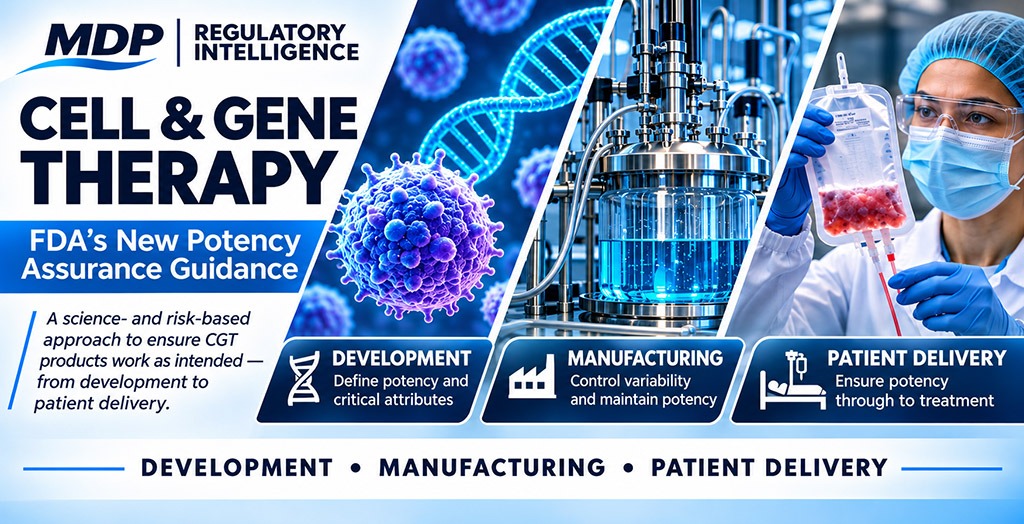
New guidance emphasizes a science- and risk-based approach to ensuring product potency throughout development, manufacturing, and commercialization.
On November 2, 2026, the U.S. Food and Drug Administration (FDA) issued final guidance, Potency Assurance for Cellular and Gene Therapy Products, providing manufacturers with updated recommendations for ensuring that cellular and gene therapy (CGT) products consistently meet established potency requirements.
The guidance replaces FDA’s 2011 potency testing guidance and introduces a broader approach centered on a Potency Assurance Strategy that integrates product quality and potency considerations throughout the therapy’s lifecycle.
Moving Beyond Final Product Testing
Potency refers to a biological product’s ability to produce its intended therapeutic effect. For cell and gene therapies, demonstrating potency can be particularly challenging because of complex manufacturing processes, biological variability, and, in some cases, extremely short product shelf lives.
Rather than relying exclusively on final product testing, FDA recommends a comprehensive, science- and risk-based strategy that incorporates controls throughout development and manufacturing.
The approach emphasizes several important areas.
Raw material controls. Managing variability in starting materials that may influence product potency.
Manufacturing process controls. Monitoring and controlling critical manufacturing steps that affect biological activity.
Potency testing. Developing appropriate laboratory assays to demonstrate biological activity relevant to the product’s intended therapeutic effect.
Lifecycle management. Maintaining potency assurance from early investigational development through commercial manufacturing and post-approval monitoring.
The guidance also addresses considerations specific to viral vector gene therapies, patient-specific products, and therapies with limited shelf lives.
Implications for Manufacturers
The final guidance encourages manufacturers to develop potency assurance strategies early in product development and refine them as manufacturing processes, analytical methods, and product knowledge evolve.
This approach is particularly important for therapies manufactured for individual patients, where limited production quantities and short turnaround times can complicate traditional testing and release procedures.
FDA’s recommendations span investigational new drug (IND) development, biologics license application (BLA) submissions, and continued post-approval verification.
For manufacturers, the guidance reinforces the importance of integrating potency assurance into process development, manufacturing controls, analytical testing, and the pharmaceutical quality system rather than treating potency as an isolated final-release testing activity.
Supporting Innovation and Patient Safety
Cell and gene therapies offer promising treatment opportunities for patients with serious or life-threatening diseases, including certain cancers and rare genetic disorders.
FDA describes the guidance as a means of providing greater regulatory clarity while maintaining appropriate quality and safety expectations for these complex biological products.
The agency will host a stakeholder webinar on December 10, 2026, to discuss the guidance and its implementation.
Read more: Eight Practical Implications for Manufacturers
When Political Priorities and FDA Science Collide
HHS proposes expanding access to six unapproved peptides despite objections from FDA scientists. This raises questions about regulatory oversight, patient safety, and the distinction between enforcement discretion and drug approval.The Trump administration is moving...
What to Know about FDA’s Revised Peptide Guidance
What Manufacturers Need to Know Seventeen revised draft product-specific guidance documents reflect FDA's evolving scientific and regulatory approach to generic peptide drug development. On July 28, 2026, the U.S. Food and Drug Administration (FDA) published 17...
The Regulatory Dilemma of Experimental Peptides
As demand for experimental peptides grows, a fundamental question confronts federal regulators. Can access to unapproved drug products expand without compromising the standards intended to protect patients? The growing popularity of experimental peptides such as...
FDA Moves Toward New Peptide Compounding Policy
FDA Moves Toward New Peptide Compounding PolicyAgency submits proposed policy change for White House review as HHS signals support for expanded access to experimental peptides Nearly three months after an FDA advisory committee recommended adding six experimental...