
The European Union
Medical Device Regulation in the European Union (EU MDR)
CE Marking, Classification, and Market Entry Requirements
The European Union Medical Device Regulation (MDR), EU MDR 2017/745, establishes one of the most comprehensive and stringent regulatory frameworks for medical devices in the world.
The MDR governs the requirements for placing medical devices on the market in the European Union and ensures that devices meet high standards of safety, performance, and clinical evidence.
For manufacturers, entry into the EU market requires a structured approach centered on CE marking, conformity assessment, and ongoing lifecycle compliance.
Regulatory Framework
The EU medical device regulatory system is governed by the MDR. The regulation replaced the Medical Device Directive (MDD) and the Active Implantable Medical Devices Directive (AIMDD). When it became fully effective in May 2021 the MDR introduced significantly stricter requirements for safety, clinical evidence, and post-market surveillance.
Device Classification System
The EU uses a four-class device risk classification system.
| Class | Risk Level | Examples |
| Class I | Low | Basic devices |
| Class IIa | Low–Moderate | Infusion pumps |
| Class IIb | Moderate–High | Ventilators |
| Class III | High | Implantable devices |
A device’s risk classification determines the level of regulatory scrutiny and whether a Notified Body must be involved in the conformity assessment process. Higher-risk devices require more extensive review.
Core Concept: CE Marking
The central requirement for EU market access is the CE Mark (Conformité Européenne). CE marking indicates that the device complies with EU regulatory requirements, the manufacturer has completed a conformity assessment, and the device meets General Safety and Performance Requirements (GSPRs). Without CE marking, a device cannot be sold in the EU.
Manufacturer Responsibility
The manufacturer must ensure compliance, prepare technical documentation, and sign the EU Declaration of Conformity. There is no central EU approval body. Compliance is demonstrated through the conformity assessment process.
Conformity Assessment
To obtain CE marking, devices must undergo a conformity assessment. Class I devices may be self-certified (with some exceptions) but still require full compliance with the MDR.
Role of Notified Bodies
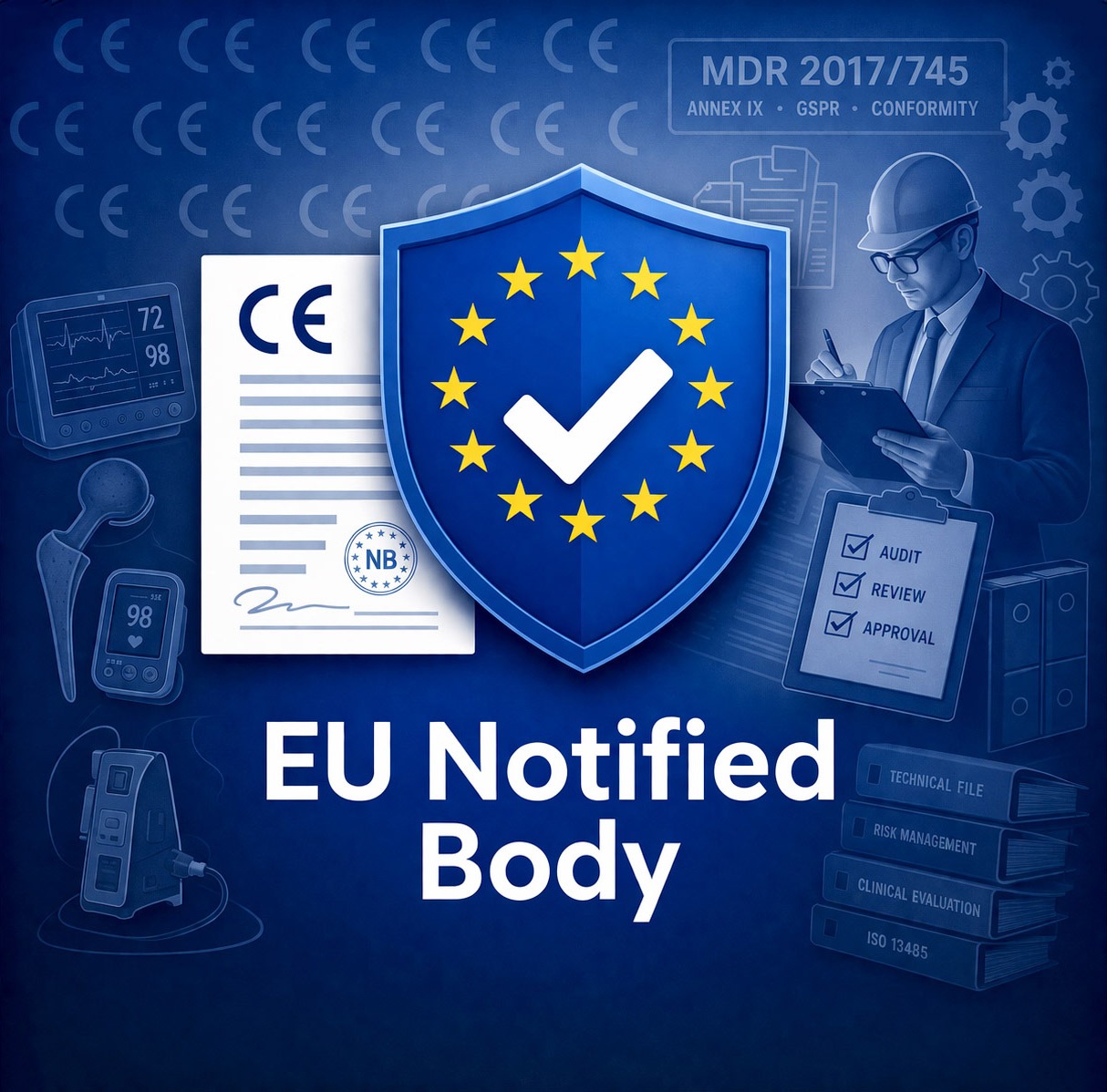
For most devices (Class IIa and above) a Notified Body must review technical documentation, audit the quality system, and issue the certification of conformity. Read more about Notified Bodies.
Key Requirements Under EU MDR
Transition from the MDD and AIMDD to the EU MDR significantly expanded regulatory expectations.
Clinical Evaluation (MAJOR CHANGE)
Manufacturers must provide clinical data demonstrating safety and performance, clinical evaluation reports, and, in some cases, clinical investigations. This is one of the biggest increases in regulatory burden.
Technical Documentation
Conformity assessment documentation must include a device description and intended use, risk management information, clinical evaluation, verification and validation data, labeling, and instructions for use. All documentation must meet detailed MDR Annex requirements.
Quality Management System
Manufacturers must implement a QMS aligned with ISO 13485 and MDR-specific requirements.
Unique Device Identification (UDI)
Unique device identification is required for lifecycle monitoring traceability.
Post-Market Surveillance (PMS)
After a product has been introduced to the EU market, manufacturers must maintain ongoing safety monitoring, periodic safety update reports (PSURs), and vigilance reporting. The EU MDR emphasizes lifecycle regulation, not just premarket approval.
Key Roles in the EU System
Manufacturer
Manufacturers are responsible for compliance and CE marking.
EU Authorized Representative (EU-REP)
Non-EU manufacturers must have an EU Authorized Representative, whose responsibilities include serving as a regulatory contact, maintaining documentation, and interfacing with authorities.
Notified Body
Notified Bodies perform the conformity assessment and issue the certification of conformity. Read more about Notified Bodies.
EUDAMED (European Database)
EU MDR introduces EUDAMED, a centralized database for device registration, economic operators, clinical investigations, and vigilance data. The system is intended to enhances transparency across the EU.
Labeling Requirements
The labeling of devices marketed in the European Economic Area must include the CE mark (visible and legible), manufacturer information, EU-REP information (if applicable), instructions for use, and translations into required EU languages.
Post-Market Requirements
EU MDR places strong emphasis on post-market activities of vigilance reporting, trend reporting, post-market surveillance (PMS) and Post-Market Clinical Follow-up (PMCF). Post-market compliance is continuous, not a one-time approval.
EU vs Other Global Markets (Quick Comparison)
| Topic | EU MDR | United States | Canada |
| Market Authorization | CE Marking | 510(k), PMA | MDL |
| Central Authority | Decentralized | FDA | Health Canada |
| Third-Party Review | Notified Bodies | Limited | Limited |
| Clinical Evidence | Extensive | Varies | Moderate |
| Quality System | ISO 13485 + MDR | QMSR | MDSAP |
| Post-Market | Strong PMS focus | Strong | Strong |
Why the EU Is a Strategic Market
The EU offers access to a large, unified market, high regulatory credibility, and global recognition of CE marking.
However, regulatory complexity is high, Notified Body availability is limited, and documentation and clinical expectations are extensive. The EU MDR is often the most demanding regulatory system manufacturers will face.
Key Challenges Under EU MDR
Under the EU MDR, manufacturers commonly face increased clinical data requirements, Notified Body availability constraints, extensive documentation demands, a transition from legacy MDD certifications, and an ongoing compliance burden.
Conclusion
EU MDR represents one of the most rigorous and comprehensive regulatory frameworks for medical devices. While it presents significant challenges, it also provides access to one of the most important global markets. Successful entry requires a structured approach, strong clinical and technical documentation, and ongoing lifecycle compliance.