
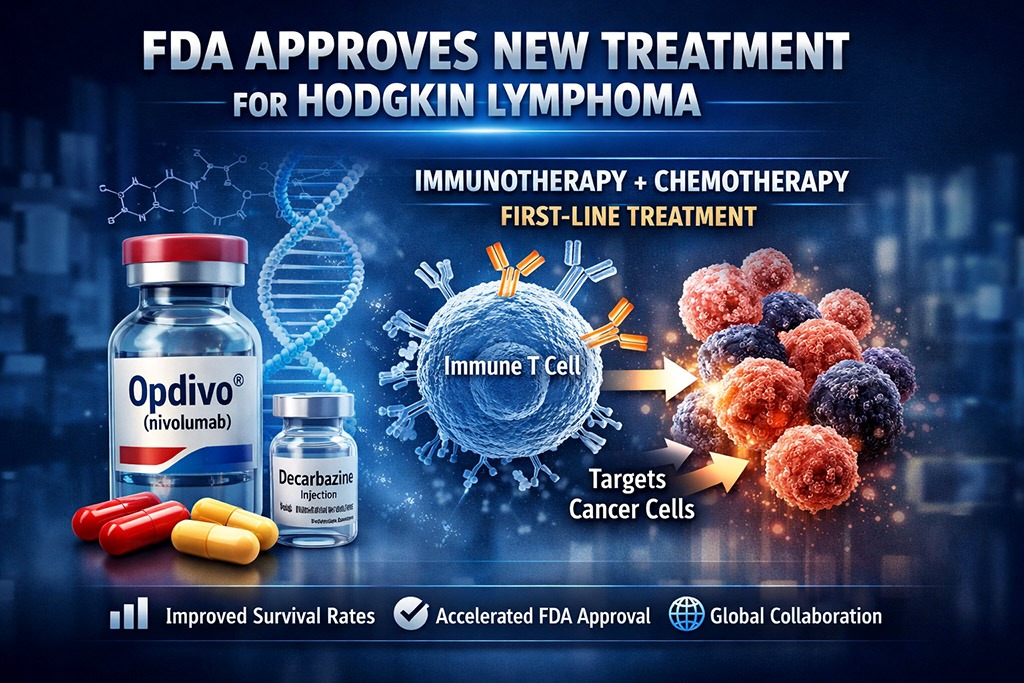
FDA Approves Nivolumab Combination Therapy for Advanced Hodgkin Lymphoma
On March 20, 2026, the U.S. Food and Drug Administration (FDA) approved nivolumab (Opdivo, Bristol Myers Squibb) in combination with chemotherapy (AVD regimen) for adult and pediatric patients (12+) with previously untreated Stage III or IV classical Hodgkin lymphoma (cHL).
The approval marks a significant expansion of nivolumab’s role from therapy used after relapse to a first-line treatment option for advanced disease.
What Changed
The approval allows nivolumab to be used upfront with Doxorubicin, Vinblastine, and Dacarbazine (AVD regimen).
In addition, FDA converted prior accelerated approvals (2016–2017) into full traditional approvals for patients after stem cell transplant and brentuximab vedotin and patients after three or more lines of therapy.
What the Clinical Results Show
In a large clinical study involving nearly 1,000 patients with advanced Hodgkin lymphoma, researchers compared this new treatment approach to the previous standard therapy. The results were encouraging.
Patients who received nivolumab with chemotherapy had a significantly lower risk of their disease getting worse or leading to death – about 42% lower compared to those on the older treatment. This is a meaningful improvement and suggests the new combination may help patients stay stable longer.
At the time of analysis, many patients in both groups were still doing well, so the average time before the disease progressed had not yet been reached. This is generally a positive sign in cancer studies.
There was also a difference in survival. About 1.8% of patients in the nivolumab group had died, compared to 3.4% in the comparison group.
Overall, these findings indicate that the nivolumab-based treatment performed better than the previous standard approach in this study.
Understanding the Safety Profile
Like all cancer treatments, this therapy comes with potential risks. In the study, about 4 out of 10 patients experienced serious side effects, around 9% had immune-related reactions, where the immune system can begin affecting normal organs, and a smaller number of participants (about 3%) had severe immune-related reactions.
Because this treatment works by activating the immune system, some side effects are different from traditional chemotherapy. These can include inflammation in organs such as the lungs, liver, or intestines. For this reason, patients receiving immunotherapy are typically closely monitored, so any side effects can be identified and treated early.
Regulatory Context
This approval was conducted under Project Orbis, enabling concurrent international review with regulators in Israel, Australia, Canada, and Switzerland. The application also received FDA Priority Review and Orphan Drug Designation.
This approval reflects a broader trend in oncology.
Immunotherapy Earlier in Treatment
Checkpoint inhibitors like nivolumab are no longer reserved for relapse. They are now entering first-line treatment settings.
Stronger Evidence Driving Conversion from Accelerated to Full Approval
FDA continues to transition therapies from accelerated pathways to traditional approval as confirmatory data matures.
Global Regulatory Alignment
Programs like Project Orbis are reshaping how oncology therapies are reviewed, moving toward a goal of simultaneous international access.
What This Means for Patients and Providers
The approval of Nivolumab combination therapy for advanced Hodgkin lymphoma has expanded first-line treatment options for advanced Hodgkin lymphoma and created the potential for improved long-term outcomes. As clinical experience grows, there will be a continued need for risk-benefit evaluation, especially with immune-related toxicities.
Bottom Line
The FDA’s approval of nivolumab with chemotherapy represents a meaningful advancement in the treatment of advanced Hodgkin lymphoma, combining improved efficacy with a well-characterized safety profile.
The Regulatory Dilemma of Experimental Peptides
As demand for experimental peptides grows, a fundamental question confronts federal regulators. Can access to unapproved drug products expand without compromising the standards intended to protect patients? The growing popularity of experimental peptides such as...
FDA Moves Toward New Peptide Compounding Policy
FDA Moves Toward New Peptide Compounding PolicyAgency submits proposed policy change for White House review as HHS signals support for expanded access to experimental peptides Nearly three months after an FDA advisory committee recommended adding six experimental...
Pharmacal Recalls MG217 Eczema Cream
Pharmacal Recalls MG217 Eczema Cream Due to Staphylococcus aureus ContaminationFDA posts nationwide recall after microbial contamination found in topical skin treatment Pharmacal has voluntarily recalled one lot of MG217 Multi-Symptom Treatment Cream & Skin...
Cefazolin Injection Recalled Due to Cardboard in Sterile IV Solution
Baxter Recalls Cefazolin Injection Sterile IV SolutionCardboard Particulate Matter Found in a Sterile Intravenous Infusion Bag Baxter International has voluntarily recalled one lot of Cefazolin in Dextrose Injection, USP, 2 g/100 mL after a report of cardboard...
FDA Closes Moringa Salmonella Outbreak Investigation
The U.S. Food and Drug Administration and the Centers for Disease Control and Prevention have concluded their investigation into a multistate Salmonella Typhimurium outbreak linked to MOGO-brand moringa powder capsules distributed by MOGO Moringa LLC of St. Louis,...
Why the Sudden Focus on Testosterone?
New Military Screening Program Raises Questions About Science, Strategy and TransparencyThe Trump administration's decision to begin annual testosterone screening for active-duty and reserve service members age 30 and older has generated headlines and a growing number...