510(k) Clearances – Robotics, AI and Diagnostics Lead the Watchlist
Overview
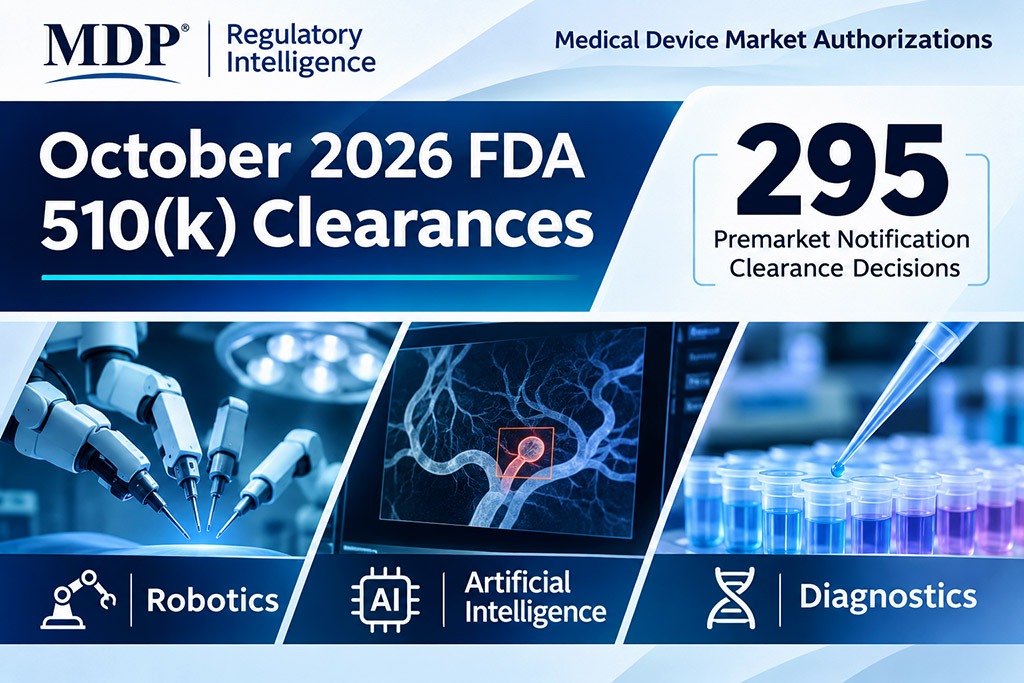
FDA issued 295 premarket notification clearance decisions during October of 2026 The records include 293 K-numbered submissions and two BK-numbered donor-testing submissions, all with decision dates from October 1 through October 30.
We screened the unique premarket notification records using device names, applicants, decision dates and initial indicators of potential significance. What we found is that October’s clearances illustrate the breadth of innovation occurring within the medical device industry, from sophisticated robotic platforms to specialized diagnostic assays and software-driven clinical tools. Click here to download the 2026 PMN clearance records.
They also demonstrate an important feature of the 510(k) pathway. Manufacturers can introduce new technologies, device modifications and expanded indications by demonstrating substantial equivalence to appropriate legally marketed predicate devices.
Robotic-assisted surgery continues to expand
Robotic platforms are evolving through additional indications. Two clearances for robotic platforms demonstrate how manufacturers can update established technologies to support additional clinical procedures. These submissions also emphasize the importance of validating new intended uses rather than assuming that previous clearance covers every application.
CMR Surgical – Versius Plus Surgical System (K261252)
FDA cleared CMR Surgical’s Versius Plus system on October 21 for specified benign gynecological procedures, expanding the system’s authorized uses in the United States. The clearance covers procedures including hysterectomy, removal of ovaries or fallopian tubes, ovarian cystectomy and treatment of adhesions in eligible adults aged 22 and older.
The development illustrates how manufacturers can expand the clinical applications of established robotic platforms through additional regulatory submissions and supporting evidence.
Neocis – Yomi S Robotic System (K261321)
FDA cleared Neocis’s Yomi S robotic system on October 13. The company subsequently announced expanded clearance supporting the placement of pterygoid dental implants, a technically demanding procedure involving implants positioned deep in the posterior upper jaw.
The clearance highlights the growing role of robotic guidance in dental surgery and the importance of procedure-specific validation when manufacturers extend the indications of an existing platform.
Artificial intelligence in diagnostic imaging
AI-enabled software remains an important area of regulatory activity. The clearances of imaging software highlight the continuing need to evaluate algorithm performance, intended users, clinical workflows and the relationship between software outputs and clinician decision-making.
Avicenna.AI – CINA-Aneurysm and CINA-Aneurysm+ (K262062 and K262147)
Two October clearances involving Avicenna.AI’s CINA-Aneurysm software products attracted attention during our 510(k) clearance screening. These products are part of the expanding category of AI-enabled medical imaging software intended to support clinical review and interpretation.
Molecular diagnostics and infectious disease testing
Diagnostic innovation extends across multiple clinical specialties. October’s records include respiratory testing, molecular diagnostics, infectious disease detection and specialized laboratory technologies.
BioFire Diagnostics – BIOFIRE SPOTFIRE Vaginitis Panel (K262136)
BioFire’s SPOTFIRE Vaginitis Panel was cleared on October 21. The clearance is noteworthy within the broader movement toward molecular diagnostic platforms that can support testing for infectious conditions.
GenMark Diagnostics – cobas eplex Respiratory Pathogen Panel 3 (K262938)
Cleared on October 30, this clearance illustrates that respiratory pathogen testing remains an important area of diagnostic development, particularly where laboratories must identify infectious agents efficiently to support patient management.
Public health and specialized clinical technologies
Centers for Disease Control and Prevention – B. anthracis Real-time PCR Assay (K262368)
The CDC’s molecular assay associated with Bacillus anthracis (the bacterium responsible for anthrax) was cleared on October 7. The submission is of particular interest from a public-health preparedness perspective.
Fertilis – microICSI Device (K262090)
Fertilis’s microICSI device, used in the field of assisted reproduction, was cleared on October 9. The submission illustrates continued device development in specialized reproductive medicine, where design and performance characteristics can be important to laboratory workflows.
Conclusion
October’s 510(k) clearances reflect an industry in which innovation is occurring across a wide range of medical technologies, from robotic-assisted procedures and artificial intelligence to molecular diagnostics and specialized clinical applications.
While not every clearance represents a major technological breakthrough, collectively they demonstrate how manufacturers continue to develop and refine devices to address evolving clinical needs.
For regulatory professionals, these developments reinforce the importance of evaluating not only what a device does, but also its intended use, supporting evidence, and the regulatory requirements that accompany its introduction into clinical practice.
The FDA Orphan Drug Program
Incentives for Rare Disease Drug Development The FDA’s Orphan Drug Program was established to encourage the development of drugs for rare diseases that affect fewer than 200,000 people in the U.S. Because these diseases often lack market incentives due to small...
FDA Grants Accelerated Approval to Multiple Myeloma Treatment
For hard-to-treat multiple myeloma On July 2, 2025, the FDA granted accelerated approval to linvoseltamab-gcpt (brand name: Lynozyfic) for adults with relapsed or refractory multiple myeloma who have received at least four prior therapies, including: A proteasome...
FDA Approves Alhemo for Patients with Hemophilia A or B
For Patients with Hemophilia A or B with Inhibitors The FDA has approved Alhemo (concizumab-mtci) for routine prophylaxis to prevent or reduce bleeding episodes in patients aged 12 and older with: Hemophilia A with factor VIII inhibitors, or Hemophilia B with factor...
First-in-Class Non-Opioid Pain Reliever: Journavx
A new non-opioid pain treatment option On January 30, 2025, the FDA granted priority review for Journavx (suzetrigine) – a first-in-class, non-opioid analgesic for treating moderate to severe acute pain in adults. How It Works Journavx targets sodium channels in the...
FDA Approves DATROWAY® Breast Cancer Treatment
A new breast cancer treatment option The United States Food and Drug Administration (FDA) approved DATROWAY® (datopotamab deruxtecan-dlnk) on January 17, 2025, for adults with hormone receptor-positive (HR+), HER2-negative breast cancer that is unresectable or...
Human Factors Engineering
Human Factors Engineering Human Factors Engineering (HFE) is critical for medical device safety and regulatory compliance, especially for Class II and III devices, drug-delivery systems, and combination products. Following is a detailed breakdown of the regulatory...
Generic Eliquis
Generic Eliquis Editor's note: FDA originally announced the approval of generic equivalents to Eliquis in 2019, and updated that information the next year. We are publishing this information as a response to reader requests for more information about generic Eliquis....
FDA Grants Accelerated Approval to Tarlatamab-dlle
Treatment for lung cancer with progression following platinum-based chemotherapy On May 16, 2024, the Food and Drug Administration (FDA) granted accelerated approval to Imdelltra (tarlatamab-dlle) manufactured by Amgen, Inc. for the treatment of extensive stage small...
FDA Approves New Imaging Drug Lumisight
A Significant Improvement for Surgical Oncology The U.S. Food and Drug Administration (FDA) has granted approval to LumiSight (pegulicianine) for use in adults undergoing breast lumpectomy, marking a significant advancement in surgical oncology. Lumisight, a...
FDA Approves XACT Carotid Stent System
A Breakthrough for Stroke Prevention Abbott Vascular Inc. has received FDA approval for its groundbreaking XACT Carotid Stent System, a significant advancement in stroke prevention technology. Approved on February 7, 2024, this innovative system offers new hope for...