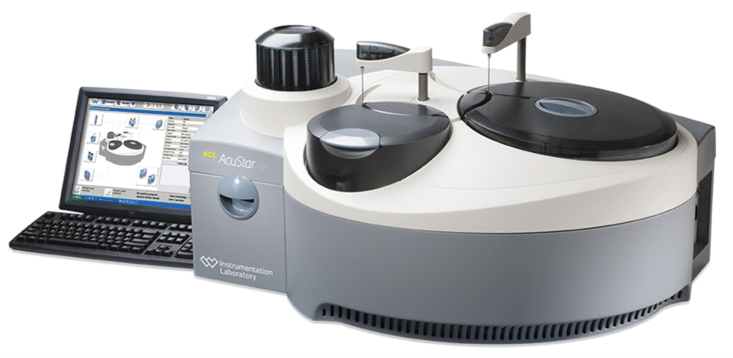
HemosIL AcuStar HIT-IgG(PF4-H). Source: fda.gov
Performance problems could produce false-negative results, potentially delaying diagnosis of a dangerous reaction to heparin.
The U.S. Food and Drug Administration (FDA) has identified a recall of certain lots of the HemosIL AcuStar HIT-IgG(PF4-H) diagnostic test, manufactured by Instrumentation Laboratories (Werfen), as the most serious type of medical device recall.
The recall involves a performance problem that could cause the test to incorrectly report negative results in patients being evaluated for heparin-induced thrombocytopenia (HIT), a potentially life-threatening reaction to the blood-thinning medication heparin.
Why the Recall Matters
Heparin is commonly used in hospitals to prevent or treat blood clots. In some patients, however, it can trigger an immune reaction that reduces platelet counts and increases the risk of dangerous blood clots.
The HemosIL AcuStar HIT-IgG(PF4-H) test helps clinicians evaluate patients for this condition by detecting antibodies associated with HIT.
According to the FDA, customer complaints identified problems with test calibration and inaccurate results. Werfen subsequently confirmed that certain lots could produce results with a negative bias of 20% to 35%, meaning the test could report antibody levels lower than their actual values.
More concerning, the problem may not be reliably detected through routine calibration and quality control testing.
As a result, some patient samples could be incorrectly reported below the test’s cutoff of 1.00 U/mL and interpreted as negative for HIT antibodies.
A false-negative result could delay recognition of HIT and influence treatment decisions. Continued heparin exposure in a patient with HIT could increase the risk of serious thrombotic complications.
Products Affected
The recall affects four lots of HemosIL AcuStar HIT-IgG(PF4-H):
| Part number | Affected lot | Expiration date |
| 0009800127 | B40005 | January 16, 2027 |
| 0009800127 | B38062 | November 1, 2026 |
| 0009802028 | B40006 | January 16, 2027 |
| 0009802028 | B38063 | November 1, 2026 |
Actions for Healthcare Facilities
Werfen has instructed affected customers to identify and destroy remaining products from the recalled lots, document the destruction, and arrange alternative HIT antibody testing methods. The company has also warned that a supply interruption is expected. Werfen’s investigation into the root cause remains ongoing.
Laboratories and treating clinicians should determine whether previously reported patient results require review, follow-up, or repeat testing based on clinical judgment and applicable procedures.
As of September 3, 2026, the company had reported no serious injuries or deaths associated with the issue.
Regulatory Intelligence Perspective
This recall illustrates an important challenge involving diagnostic devices, that a test can produce an apparently valid result even when its analytical performance is compromised. The reported negative bias is particularly concerning because routine calibration and quality control procedures may not reliably identify the problem.
For diagnostic manufacturers and clinical laboratories, the recall underscores the importance of investigating performance complaints, evaluating potential effects on previously reported patient results, and assessing whether existing quality controls are capable of detecting clinically significant failures.
The case also demonstrates why postmarket surveillance and effective corrective action processes are essential throughout a diagnostic device’s commercial life.
Additional information
U.S. customers may contact Werfen Client Services at 1-800-955-9525. FDA recall information is available through the agency’s Medical Device Recalls and Early Alerts website.
FDA Requires New GLP-1 Drug Warning for Vision Loss Risk
Agency cites potential increased risk of rare optic nerve condition following review of clinical trials and postmarket safety dataThe U.S. Food and Drug Administration (FDA) is requiring manufacturers of all glucagon-like peptide-1 receptor agonist (GLP-1 RA)...
FDA Approves Amplatzer Paraclose for Heart Valve Leaks
Abbott's Amplatzer Paraclose PVL Occluder offers a minimally invasive alternative for patients who develop a significant complication following heart valve replacement surgery.Heart valve replacement surgery can be lifesaving for patients with damaged or diseased...
October 2026 Premarket Approval (PMA) Authorizations
Three original device approvals and 218 supplements / noticesFDA's October activity highlights three newly approved medical devices and the extensive regulatory oversight required to maintain and modify products already on the market.The U.S. Food and Drug...
A Heart Valve Designed to Grow with Children
The new pediatric heart valve could reduce the need for repeat surgeries, but FDA requires additional studies to establish its long-term benefits.Children born with certain heart conditions may face multiple surgeries as they grow. One reason is surprisingly simple:...
FDA Clears AI Software for Automated Kidney Volume Assessment
AIRA uses artificial intelligence to analyze CT images and measure kidney volume, offering clinicians an automated tool for renal assessment. FDA Authorization Item Information Device Artificial Intelligence Renal Assessment (AIRA) Version 1 Manufacturer Aramis Global...
FDA Approves SELUTION SLR Drug-Eluting Balloon
SELUTION SLR Drug-Eluting Balloon. Source: MedAlliance LLCNew PMA approval introduces a sirolimus-eluting balloon treatment for coronary arteries, supported by randomized clinical evidence and ongoing post-approval surveillance. FDA approved the SELUTION SLR™ 014 PTCA...
Major Quality System Failures at Cardiac Device Manufacturer
Agency cites device classification disputes, inadequate manufacturing controls, and quality system deficiencies dating back to 2011An August 26, 2026, FDA warning letter to Peter Schiff Enterprises, a Tennessee manufacturer of cardiac devices, describes a troubling...
Cefazolin Injection Recalled Due to Cardboard in Sterile IV Solution
Baxter Recalls Cefazolin Injection Sterile IV SolutionCardboard Particulate Matter Found in a Sterile Intravenous Infusion Bag Baxter International has voluntarily recalled one lot of Cefazolin in Dextrose Injection, USP, 2 g/100 mL after a report of cardboard...
FDA Early Alert for Baxter Intravascular Administration Sets
Healthcare facilities are instructed to immediately stop using affected IV solution sets while FDA evaluates the potentially high-risk device issueThe U.S. Food and Drug Administration (FDA) has issued an Early Alert regarding certain Baxter Duo-Vent Solution Sets...
Class I Recall for Bolton Medical RelayPro Thoracic Stent Graft
FDA Issues Class I Recall for RelayPro Thoracic Stent Graft Following Three Patient DeathsDeployment failure during aortic repair may require emergency open surgery The U.S. Food and Drug Administration (FDA) has issued a Class I recall for certain RelayPro Thoracic...