Vivasure Medical’s PerQseal Elite offers a minimally invasive approach to closing large arterial openings following cardiovascular procedures.
Vivasure Medical’s PerQseal Elite offers a minimally invasive approach to closing large arterial openings following cardiovascular procedures.
Many advanced cardiovascular procedures begin with a small puncture in the femoral artery, near the groin. Physicians insert catheters and specialized instruments through the opening to repair heart valves, treat aneurysms, or perform other procedures without traditional open surgery. But when the procedure is finished, an important challenge remains. How do you safely close the opening in the artery and prevent bleeding?
On October 16, 2026, the U.S. Food and Drug Administration (FDA) approved the PerQseal Elite Vascular Closure Device, developed by Ireland-based Vivasure Medical, a subsidiary of Haemonetics Corporation. The device offers physicians another option for closing relatively large openings in the common femoral artery following minimally invasive cardiovascular procedures.
A Small Implant Designed to Seal a Large Opening
During procedures such as transcatheter aortic valve replacement (TAVR) or endovascular aneurysm repair (EVAR), physicians may use relatively large catheters to deliver medical devices through the arteries. Once those instruments are removed, the access site must be securely closed. Depending on the procedure and patient, physicians may use sutures, other vascular closure devices, or surgical repair.
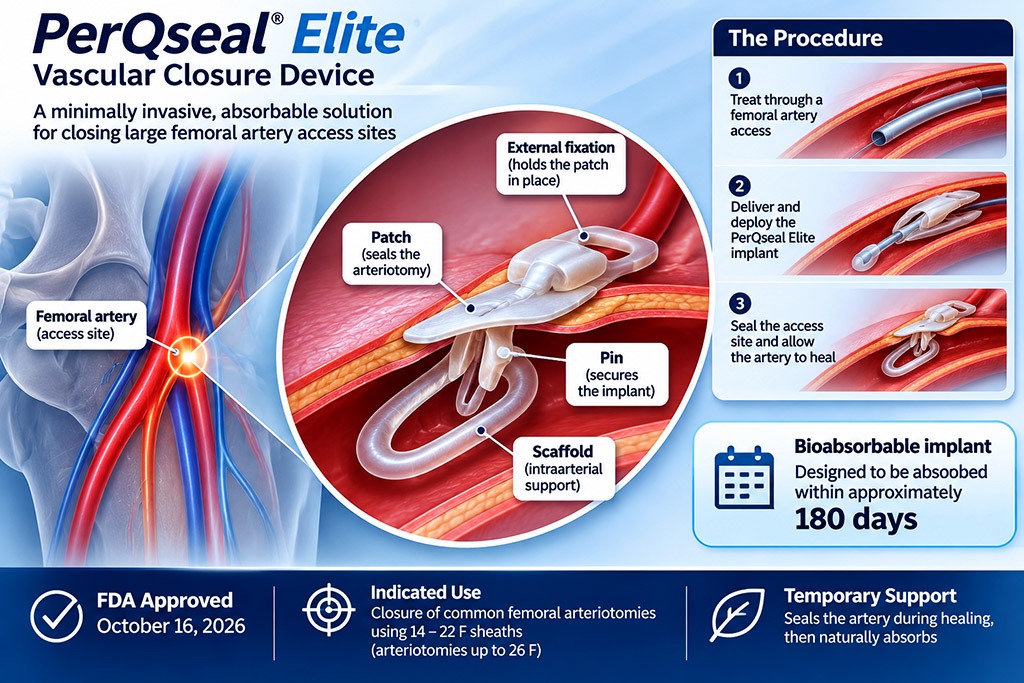
PerQseal Elite takes a different approach. The device delivers a small, flexible implant made from polydioxanone, a synthetic material designed to gradually break down and be absorbed by the body. The implant has components positioned inside and outside the artery to help seal the opening and hold the closure in place.
Unlike permanent implants, PerQseal Elite is designed to be absorbed within approximately 180 days, after the artery has had time to heal. The FDA approved the device for closing common femoral artery openings following endovascular catheterization procedures using 14–22 French sheaths, including arterial openings up to 26 French.
What Did the Clinical Study Find?
FDA’s approval was supported by laboratory testing, animal studies, and clinical evidence, including the ELITE study conducted at European clinical centers. The study evaluated the device’s ability to close arterial access sites and examined complications associated with its use.
Among the findings:
- Average time to stop bleeding: 0.9 minutes in the primary effectiveness analysis.
- Technical success: 88.9% of procedures (112 of 126).
- Treatment success: 89.0% of evaluable patients (105 of 118).
- Major device-related access-site complications: 3.4% (4 of 118 patients) through 30 days in the primary safety analysis.
The four major complications involved vascular injuries requiring surgical repair or placement of a stent graft.
The study met its prespecified safety and effectiveness performance goals, supporting FDA’s determination that the device provides reasonable assurance of safety and effectiveness for its approved use. However, the ELITE study was not a randomized head-to-head comparison with another vascular closure device. Its findings should not be interpreted as demonstrating superiority over existing closure methods.
Why the Approval Matters
As minimally invasive cardiovascular procedures become increasingly sophisticated, the devices used to support those procedures must evolve as well. Closing a large arterial opening can be a critical step in completing an intervention safely. A device that can achieve closure through a catheter-based approach, without leaving a permanent implant, provides an additional option for appropriately selected patients.
PerQseal Elite also illustrates the growing role of bioabsorbable materials in medical device development. Rather than remaining permanently in the body, the implant is designed to provide temporary mechanical support while the access site heals.
The technology is not appropriate for every patient. Its labeling includes important restrictions involving blood vessel diameter, puncture location, vascular disease, and other anatomical considerations. Physicians must receive device-specific training before use.
FDA Approval Is Not the End of the Evaluation
As a condition of approval, FDA requires Vivasure Medical to conduct a U.S. postapproval study involving at least 150 patients at five or more clinical centers. The study will evaluate the device’s safety and performance in routine U.S. clinical practice, including complications, technical success, and device deficiencies during the first 30 days following treatment. These additional data will help FDA continue evaluating the device after its introduction to the U.S. market.
PerQseal Elite represents another step toward making complex cardiovascular procedures less invasive—not by changing how physicians reach the heart or blood vessels, but by improving the options available for safely closing the access site when the procedure is complete.
April 2026 Update for FDA QMSR Inspection Results
April 2026 Update for FDA QMSR Inspection ResultsConfirming the Shift to System-Level, Risk-Based Inspection When FDA’s Quality Management System Regulation (QMSR) took effect on February 2, 2026, the regulatory framework became formally aligned with ISO 13485. What...
Medline Recalls Angiographic RA Control Syringes
Angiographic Syringe Recall: Medline Removes RA Control Syringes Due to Risk of Disconnection and Air Embolism The U.S. Food and Drug Administration (FDA) has announced that Medline Industries has issued an Urgent Medical Device Recall involving certain Namic...
FDA Class I Recall for Abiomed Impella Gen 1 Purge Cassettes
Medical Device Alert: Abiomed Impella Purge Cassette Recall (Class I) Abiomed has initiated a Class I recall, the most serious classification issued by the U.S. Food and Drug Administration, for certain Impella purge cassettes and associated pump sets due to a...
Class I Correction for Abiomed Impella Inaccurate Flow Readings
Abiomed Impella RP: FDA Class I Correction for Inaccurate Flow Readings Abiomed has issued an Urgent Medical Device Correction for its Impella RP with SmartAssist and Impella RP Flex with SmartAssist systems due to potential inaccuracies in displayed pump performance...
Nivolumab Combination Therapy for Advanced Hodgkin Lymphoma
FDA Approves Nivolumab Combination Therapy for Advanced Hodgkin Lymphoma On March 20, 2026, the U.S. Food and Drug Administration (FDA) approved nivolumab (Opdivo, Bristol Myers Squibb) in combination with chemotherapy (AVD regimen) for adult and pediatric patients...