510(k) Clearances – Robotics, AI and Diagnostics Lead the Watchlist
Overview
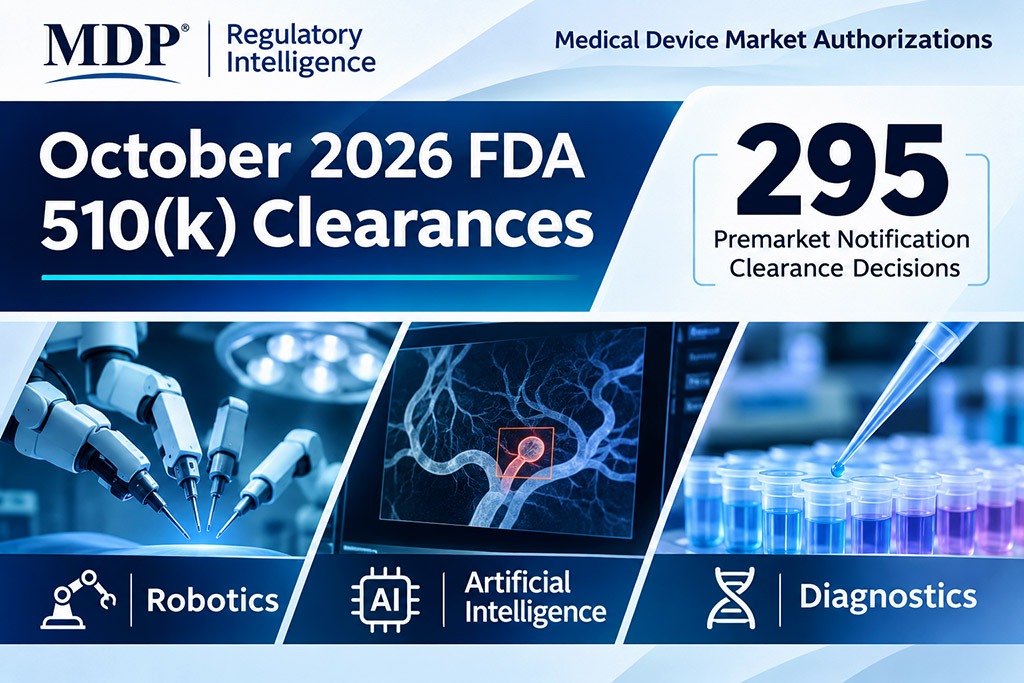
FDA issued 295 premarket notification clearance decisions during October of 2026 The records include 293 K-numbered submissions and two BK-numbered donor-testing submissions, all with decision dates from October 1 through October 30.
We screened the unique premarket notification records using device names, applicants, decision dates and initial indicators of potential significance. What we found is that October’s clearances illustrate the breadth of innovation occurring within the medical device industry, from sophisticated robotic platforms to specialized diagnostic assays and software-driven clinical tools. Click here to download the 2026 PMN clearance records.
They also demonstrate an important feature of the 510(k) pathway. Manufacturers can introduce new technologies, device modifications and expanded indications by demonstrating substantial equivalence to appropriate legally marketed predicate devices.
Robotic-assisted surgery continues to expand
Robotic platforms are evolving through additional indications. Two clearances for robotic platforms demonstrate how manufacturers can update established technologies to support additional clinical procedures. These submissions also emphasize the importance of validating new intended uses rather than assuming that previous clearance covers every application.
CMR Surgical – Versius Plus Surgical System (K261252)
FDA cleared CMR Surgical’s Versius Plus system on October 21 for specified benign gynecological procedures, expanding the system’s authorized uses in the United States. The clearance covers procedures including hysterectomy, removal of ovaries or fallopian tubes, ovarian cystectomy and treatment of adhesions in eligible adults aged 22 and older.
The development illustrates how manufacturers can expand the clinical applications of established robotic platforms through additional regulatory submissions and supporting evidence.
Neocis – Yomi S Robotic System (K261321)
FDA cleared Neocis’s Yomi S robotic system on October 13. The company subsequently announced expanded clearance supporting the placement of pterygoid dental implants, a technically demanding procedure involving implants positioned deep in the posterior upper jaw.
The clearance highlights the growing role of robotic guidance in dental surgery and the importance of procedure-specific validation when manufacturers extend the indications of an existing platform.
Artificial intelligence in diagnostic imaging
AI-enabled software remains an important area of regulatory activity. The clearances of imaging software highlight the continuing need to evaluate algorithm performance, intended users, clinical workflows and the relationship between software outputs and clinician decision-making.
Avicenna.AI – CINA-Aneurysm and CINA-Aneurysm+ (K262062 and K262147)
Two October clearances involving Avicenna.AI’s CINA-Aneurysm software products attracted attention during our 510(k) clearance screening. These products are part of the expanding category of AI-enabled medical imaging software intended to support clinical review and interpretation.
Molecular diagnostics and infectious disease testing
Diagnostic innovation extends across multiple clinical specialties. October’s records include respiratory testing, molecular diagnostics, infectious disease detection and specialized laboratory technologies.
BioFire Diagnostics – BIOFIRE SPOTFIRE Vaginitis Panel (K262136)
BioFire’s SPOTFIRE Vaginitis Panel was cleared on October 21. The clearance is noteworthy within the broader movement toward molecular diagnostic platforms that can support testing for infectious conditions.
GenMark Diagnostics – cobas eplex Respiratory Pathogen Panel 3 (K262938)
Cleared on October 30, this clearance illustrates that respiratory pathogen testing remains an important area of diagnostic development, particularly where laboratories must identify infectious agents efficiently to support patient management.
Public health and specialized clinical technologies
Centers for Disease Control and Prevention – B. anthracis Real-time PCR Assay (K262368)
The CDC’s molecular assay associated with Bacillus anthracis (the bacterium responsible for anthrax) was cleared on October 7. The submission is of particular interest from a public-health preparedness perspective.
Fertilis – microICSI Device (K262090)
Fertilis’s microICSI device, used in the field of assisted reproduction, was cleared on October 9. The submission illustrates continued device development in specialized reproductive medicine, where design and performance characteristics can be important to laboratory workflows.
Conclusion
October’s 510(k) clearances reflect an industry in which innovation is occurring across a wide range of medical technologies, from robotic-assisted procedures and artificial intelligence to molecular diagnostics and specialized clinical applications.
While not every clearance represents a major technological breakthrough, collectively they demonstrate how manufacturers continue to develop and refine devices to address evolving clinical needs.
For regulatory professionals, these developments reinforce the importance of evaluating not only what a device does, but also its intended use, supporting evidence, and the regulatory requirements that accompany its introduction into clinical practice.
FDA Clears First OTC Continuous Glucose Monitor for Children
Regulatory Snapshot Device: Stelo® Glucose Biosensor System (Dexcom, Inc.)Indication: Continuous glucose monitoring for individuals ages 2 years and older who do not use insulin, including children with diabetes managed through oral medications and individuals seeking...
FDA-Approved Vivistim: A New Pathway in Stroke Recovery
Vivistim implantable vagus nerve stimulator. Source: Vivistim.com.FDA-Approved Vagus Nerve Stimulation Device Opens a New Pathway in Stroke Recovery A company behind one of the world’s most closely watched neurorehabilitation technologies is preparing for a major new...
FDA Approves First Gene Therapy for Genetic Hearing Loss
FDA Approves First Gene Therapy for Genetic Hearing LossRapid Review and Breakthrough Science Converge in Landmark OTOF Therapy The FDA has approved Otarmeni (lunsotogene parvec-cwha), the first gene therapy for a form of inherited hearing loss caused by mutations in...
Nivolumab Combination Therapy for Advanced Hodgkin Lymphoma
FDA Approves Nivolumab Combination Therapy for Advanced Hodgkin Lymphoma On March 20, 2026, the U.S. Food and Drug Administration (FDA) approved nivolumab (Opdivo, Bristol Myers Squibb) in combination with chemotherapy (AVD regimen) for adult and pediatric patients...
FDA’s AEMS: Real-Time Drug and Device Safety Monitoring
FDA’s AEMS: The Beginning of Real-Time Drug and Device Safety MonitoringThe U.S. Food and Drug Administration has launched a new platform that could fundamentally reshape how post-market safety signals are detected and analyzed. Announced on March 11, 2026, the FDA...
FDA Approves Cerebral Folate Transport Deficiency Treatment
FDA Approves First Treatment for Cerebral Folate Transport Deficiency The U.S. Food and Drug Administration (FDA) has approved an expanded use of Wellcovorin (leucovorin calcium) tablets to treat patients with cerebral folate deficiency caused by variants in the...
FDA Streamlines Biosimilar Development to Reduce Drug Costs
FDA Moves to Streamline Biosimilar Development and Reduce Drug Costs The U.S. Food and Drug Administration (FDA) has announced new steps to simplify the development pathway for biosimilar medicines, a move intended to reduce development costs and improve patient...
FDA Approves Novel Device for Pancreatic Cancer Treatment
FDA Approves Novel Device for Pancreatic Cancer Treatment The U.S. Food and Drug Administration has approved Optune Pax, a first-of-its-kind medical device designed to treat adult patients with locally advanced pancreatic cancer. Developed by Novocure, the portable...
FDA “PreCheck” Program to Boost U.S. Drug Manufacturing
FDA Announces New PreCheck Drug Manufacturing Program The U.S. Food and Drug Administration (FDA) has announced the launch of FDA PreCheck, a groundbreaking new program designed to strengthen America’s domestic pharmaceutical supply chain by streamlining the...
What Are Early Recall Alerts?
Recall Communication “Early Alerts” Note: This summary is based on an FDA communication attributed to Michelle Tarver, M.D., Ph.D., director of the Center for Devices and Radiological Health (CDRH). In November 2024 the U.S. Food and Drug Administration’s Center for...