293 Clearances and Two De Novo Grants
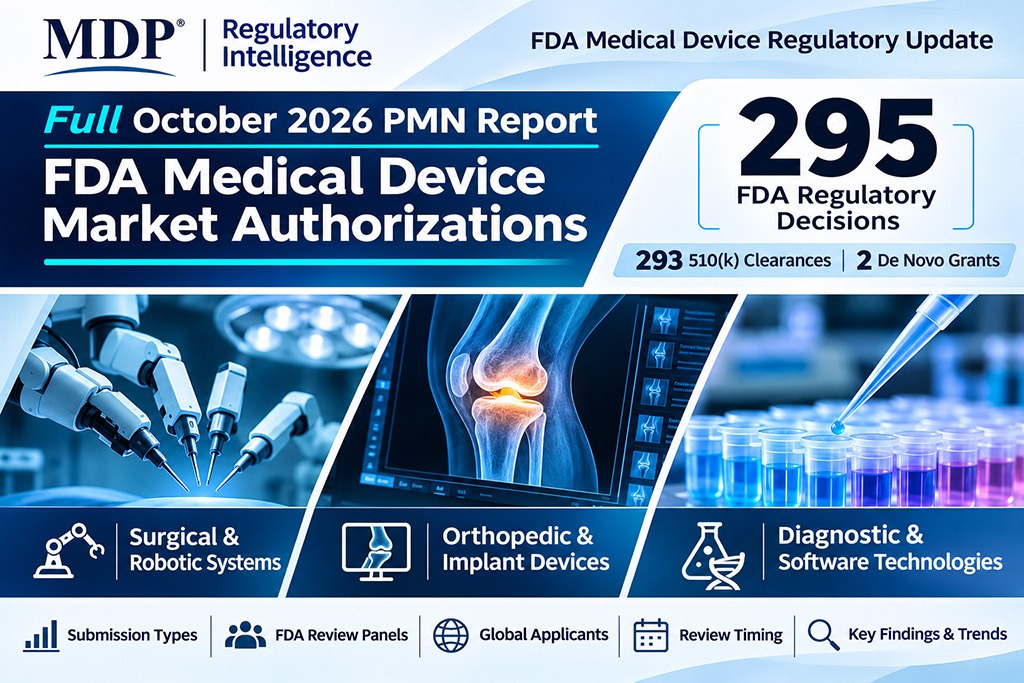
Traditional 510(k) submissions dominate October decisions, while orthopedic, surgical, cardiovascular, and radiology devices lead FDA clearance activity.
The U.S. Food and Drug Administration (FDA) recorded 295 medical device regulatory decisions during October 2026, consisting of 293 premarket notification (510(k)) clearances and two De Novo classification grants, according to an analysis conducted by Medical Devices and Pharma (MDP).
The results provide a snapshot of medical device regulatory activity, including submission pathways, FDA review panels, applicant geography, and the time elapsed between submission receipt and regulatory decision.
MDP’s Full October 2026 PMN Report provides additional analysis of these findings, including noteworthy regulatory patterns, unusual records, and selected medical technologies.
Traditional 510(k) Submissions Account for More Than 80% of Clearances
Of the 293 devices receiving 510(k) clearance, Traditional submissions represented the overwhelming majority.
| Submission type | Clearances | Percentage |
| Traditional 510(k) | 238 | 81.2% |
| Special 510(k) | 50 | 17.1% |
| Dual Track | 3 | 1.0% |
| Abbreviated 510(k) | 2 | 0.7% |
| Total | 293 | 100% |
Two additional decisions involved the De Novo classification pathway, which provides a regulatory route for certain novel devices without a legally marketed predicate.
The relatively small number of Special and Abbreviated submissions illustrates the continued dominance of the Traditional 510(k) pathway among October clearances. However, these figures represent decisions issued during the month, not all submissions received by FDA.
Orthopedic, Surgical, and Cardiovascular Devices Lead Clearance Activity
FDA review-panel assignments reveal where October’s clearance activity was concentrated.
| FDA review panel | Clearances |
| Orthopedic | 42 |
| General & Plastic Surgery | 40 |
| Cardiovascular | 34 |
| Radiology | 33 |
| Neurology | 25 |
| Dental | 24 |
| General Hospital | 19 |
| Microbiology | 17 |
| Gastroenterology/Urology | 13 |
| Physical Medicine | 11 |
| Clinical Chemistry | 10 |
| Obstetrics/Gynecology | 7 |
The six leading review panels accounted for 198 clearances, approximately 67.6% of all October 510(k) decisions.
These figures reflect FDA review-panel assignments rather than a definitive classification of device technologies. Nevertheless, they illustrate the breadth of medical device activity, ranging from orthopedic implants and surgical instruments to cardiovascular technologies, diagnostic imaging, and software.
U.S. and Chinese Applicants Represent Nearly Three-Quarters of Decisions
Applicant geography provides another perspective on the global medical device industry.
Of the 295 decisions, 155 involved applicants with U.S. addresses (52.5%), while 61 involved applicants in China (20.7%). South Korea followed with 18 decisions (6.1%), Germany with nine (3.1%), and the United Kingdom with seven (2.4%). Other countries represented included Israel, Taiwan, France, Switzerland, and Belgium. Together, U.S. and Chinese applicants accounted for 73.2% of October decisions.
Importantly, applicant location does not necessarily indicate where a device is manufactured or the nationality of its ultimate corporate owner.
Submission Timing Reveals Significant Differences
MDP also examined the elapsed calendar time between the dates FDA recorded submissions as received and the dates regulatory decisions were issued.
The median elapsed time for Traditional 510(k) submissions was 140.5 calendar days, compared with 30 days for Special 510(k) submissions. Other categories showed median elapsed times of 180 days for Dual Track submissions, 204 days for Abbreviated submissions, and 267 days for the two De Novo decisions.
These differences are noteworthy but require careful interpretation. The calculations include all calendar days between receipt and decision, including periods when submissions may have been on hold or applicants were responding to additional-information requests. They are not equivalent to FDA review-clock measurements and should not be interpreted as evidence of comparative FDA review performance.
The substantially shorter median observed for Special 510(k) submissions is consistent with the pathway’s more limited scope, although the dataset alone cannot establish why individual decisions took less time.
Robotics, Imaging, and Diagnostic Technologies Highlight Innovation
Several October decisions illustrate the continued development of advanced medical technologies.
Among the notable examples were:
Neocis Yomi S Robotic System (K261321): A robotic dental technology.
CMR Surgical Versius Surgical System, Versius Plus (K261252): A robotic surgical platform.
Virtuoso Surgical Virtuoso Endoscopy System (DEN250054): One of October’s two De Novo grants.
Roche Diagnostics Elecsys HBsAg II quant II RxDx (DEN260027): The month’s other De Novo grant.
The dataset also includes numerous imaging, diagnostic, and software-based medical devices.
These examples suggest several areas worth monitoring, particularly robotic-assisted procedures, diagnostic technologies, and software applications in clinical practice.
However, identifying devices that incorporate artificial intelligence or machine learning requires additional examination of FDA clearance summaries and intended-use information. Device names alone are insufficient to establish the extent of AI-related clearance activity.
Noteworthy Regulatory Patterns and Data Anomalies
MDP identified several additional findings during its analysis.
Third-party reviews remain relatively uncommon. Only four of the 293 510(k) clearances were identified as third-party reviewed, representing approximately 1.4% of the total.
Two unusually short decision intervals deserve closer examination. Submissions K263680 and K263860 each showed only one calendar day between the recorded receipt and decision dates. Both were identified as third-party reviewed. These records warrant verification before conclusions can be drawn about the review process.
One decision was recorded on a Sunday. Submission K253717, involving the Helo Return device from Endovascular Engineering, carried a decision date of October 11, 2026. This may reflect an administrative or reporting convention, but the dataset does not establish the reason.
Manufacturer comparisons require additional normalization. The dataset contained 268 distinct applicant-name entries across 295 decisions. Differences in corporate naming, subsidiaries, and formatting can complicate comparisons of manufacturer activity.
Expedited review information was unavailable. The relevant field was blank throughout the dataset, preventing meaningful conclusions about expedited review activity.
These observations illustrate why regulatory intelligence involves more than simply counting FDA decisions. Understanding the significance of regulatory data requires attention to submission pathways, reporting conventions, data quality, and the limitations of available information.
What FDA’s October PMN Clearance Results Tell Us
October’s FDA decisions demonstrate the continued importance of the Traditional 510(k) pathway, substantial activity across established medical device specialties, and the international scope of the U.S. medical device market.
At the same time, emerging surgical, diagnostic, and software technologies illustrate how innovation continues to develop within existing regulatory pathways and through De Novo classifications.
For manufacturers and regulatory professionals, the findings reinforce the importance of understanding the appropriate submission pathway, preparing complete regulatory documentation, and recognizing how device characteristics and regulatory requirements influence market authorization.
Regulatory intelligence is most valuable when it goes beyond reporting what FDA has done to help industry professionals understand what the information means. MDP’s comprehensive report includes the complete submission-pathway breakdown, review-panel distribution, applicant geography, decision-timing analysis, selected medical technologies, and eight noteworthy regulatory findings and anomalies.
Editor’s Note: The analysis is based on FDA’s October 2026 monthly decision extract. Results reflect decisions recorded during the reporting period and may be subject to subsequent FDA database updates. MDP’s analysis is independent and is not an official FDA publication.
View and Download the FULL October 2026 PMN Report
FDA Approves First Treatment to Reduce Risk of Acute Pancreatitis
FDA Approves First Treatment Proven to Reduce Acute Pancreatitis Risk in Severe HypertriglyceridemiaAn important example of the distinction between surrogate endpoints and clinical outcomes in drug development The U.S. Food and Drug Administration (FDA) has approved...
FDA Clears First OTC Continuous Glucose Monitor for Children
Regulatory Snapshot Device: Stelo® Glucose Biosensor System (Dexcom, Inc.)Indication: Continuous glucose monitoring for individuals ages 2 years and older who do not use insulin, including children with diabetes managed through oral medications and individuals seeking...
FDA-Approved Vivistim: A New Pathway in Stroke Recovery
Vivistim implantable vagus nerve stimulator. Source: Vivistim.com.FDA-Approved Vagus Nerve Stimulation Device Opens a New Pathway in Stroke Recovery A company behind one of the world’s most closely watched neurorehabilitation technologies is preparing for a major new...
FDA Approves First Gene Therapy for Genetic Hearing Loss
FDA Approves First Gene Therapy for Genetic Hearing LossRapid Review and Breakthrough Science Converge in Landmark OTOF Therapy The FDA has approved Otarmeni (lunsotogene parvec-cwha), the first gene therapy for a form of inherited hearing loss caused by mutations in...
Nivolumab Combination Therapy for Advanced Hodgkin Lymphoma
FDA Approves Nivolumab Combination Therapy for Advanced Hodgkin Lymphoma On March 20, 2026, the U.S. Food and Drug Administration (FDA) approved nivolumab (Opdivo, Bristol Myers Squibb) in combination with chemotherapy (AVD regimen) for adult and pediatric patients...
FDA’s AEMS: Real-Time Drug and Device Safety Monitoring
FDA’s AEMS: The Beginning of Real-Time Drug and Device Safety MonitoringThe U.S. Food and Drug Administration has launched a new platform that could fundamentally reshape how post-market safety signals are detected and analyzed. Announced on March 11, 2026, the FDA...
FDA Approves Cerebral Folate Transport Deficiency Treatment
FDA Approves First Treatment for Cerebral Folate Transport Deficiency The U.S. Food and Drug Administration (FDA) has approved an expanded use of Wellcovorin (leucovorin calcium) tablets to treat patients with cerebral folate deficiency caused by variants in the...
FDA Streamlines Biosimilar Development to Reduce Drug Costs
FDA Moves to Streamline Biosimilar Development and Reduce Drug Costs The U.S. Food and Drug Administration (FDA) has announced new steps to simplify the development pathway for biosimilar medicines, a move intended to reduce development costs and improve patient...
FDA Approves Novel Device for Pancreatic Cancer Treatment
FDA Approves Novel Device for Pancreatic Cancer Treatment The U.S. Food and Drug Administration has approved Optune Pax, a first-of-its-kind medical device designed to treat adult patients with locally advanced pancreatic cancer. Developed by Novocure, the portable...
FDA “PreCheck” Program to Boost U.S. Drug Manufacturing
FDA Announces New PreCheck Drug Manufacturing Program The U.S. Food and Drug Administration (FDA) has announced the launch of FDA PreCheck, a groundbreaking new program designed to strengthen America’s domestic pharmaceutical supply chain by streamlining the...