
Advancing from Basic Design to Usability
In a world shifting toward user-centered regulation, even the simplest medical devices can demonstrate why human factors and usability engineering matter.
The FDA’s Quality Management System Regulation (QMSR) – which aligns with ISO 13485:2016 – emphasizes risk-based thinking and user-focused design.
That expectation extends beyond complex systems to the everyday tools that affect patients’ health, safety, and adherence.
The Case: A Class I Pill organizer
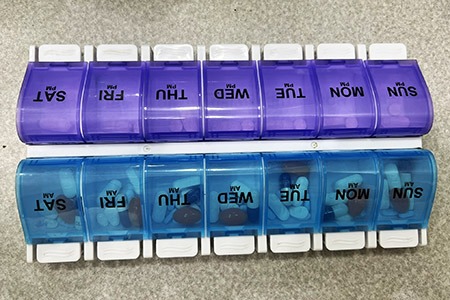
The product in question – a sturdy, two-row, AM/PM pill organizer – appears well-designed at first glance.
Known to FDA as a Class I Solid Medication Dispenser (product code NXB), the FDA definition for the product is “a device intended for medical purposes that is used to issue solid (pills) medication.”
It is made of durable plastic, features secure latches that won’t inadvertently open if it is dropped, and provides clear day-of-week labeling. By traditional product engineering inputs, it’s solid.
But by usability and human-factors standards, it could be improved.
Consider the User
The primary users of this product are individuals managing multiple medications – and they could be elderly, visually impaired, cognitively challenged, or have another condition that will challenge their interaction with the device. For these users, human factors design oversights could translate into real-world risks. This includes:
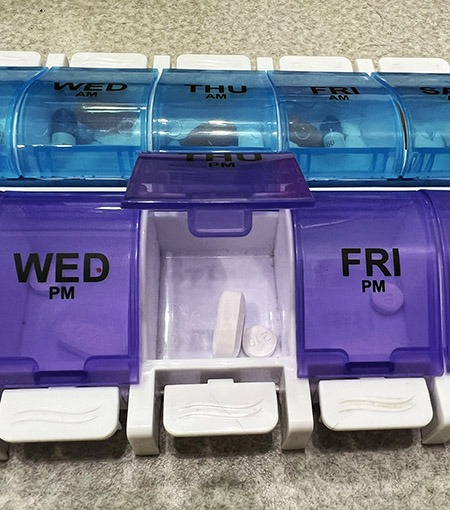
Color confusion. Dark blue (AM) and purple (PM) compartments provide insufficient contrast for those with color-perception limitations or poor lighting.
Label orientation. All text faces the same direction, instead of aligning with the natural opening direction – creating potential confusion between morning and evening doses.
Font and contrast. The black-on-transparent plastic labeling offers limited legibility under household lighting, particularly for users with cataracts or macular degeneration.
Cognitive load. With twice-daily dosing and similar-looking compartments, users must mentally track “what’s next” instead of relying on intuitive design cues.
Each of these issues, while perhaps minor in isolation, contributes to the cumulative risk of medication error – precisely the kind of risk that ISO 14971 (Risk Management for Medical Devices) and ANSI/AAMI HE75 (Human Factors Engineering) seek to minimize.

Why It Matters
For this and many other Class I medical devices, design controls are not typically required and risk assessments may not identify usability as a hazard. Yet under the QMSR’s philosophy – which emphasizes effectiveness and safety through the total product lifecycle – this device is a perfect example of why usability risk must be part of every device manufacturer’s thinking.
A pill taken at the wrong time of day can render a therapy ineffective – or dangerous. That is not a user failure. It’s a design failure.
In fact, the device classification has been named in Medical Device Reports (MDRs). There were four MDR events and reports last year and one so far this year. In 2024, there were 23 MDR reports that documented 24 adverse events.
It is important to understand that the product category includes computerized medication delivery systems that were the cause of some MDRs; but even with additional complexity of an automated system, the basic design considerations apply.
Reported device problems included patient-device interaction problems, mechanical problems, product quality problems, device markings/labeling problems, and structural problems. A complete set of reported problems is listed on FDA’s Total Product Lifecycle Page for the device’s product code (NXB).
Read more about Human Factors Engineering principles, processes, requirements, and guidance here.

Toward Smarter Simplicity
The goal of developing this device is to not over-engineer it. It is to design empathy into simplicity. A few modest changes could transform this pill organizer into a safer device:
- Increase the color contrast between AM and PM rows (e.g., blue and white or yellow and gray).
- Orient text toward each compartment’s latch.
- Use high-contrast, bold, sans-serif labeling.
- Include a tactile or auditory cue (a click or raised marking) for compartments.
These aren’t just good design ideas – they help to accomplishes complian with the QMSR’s intent: to design for people, not just for products.
Improved Usability: Learning from a Better Design
After initially making these observations (every morning while taking my medication and vitamins), during a trip to Walmart I noticed a product that shows how simple design refinements can dramatically improve design usability.
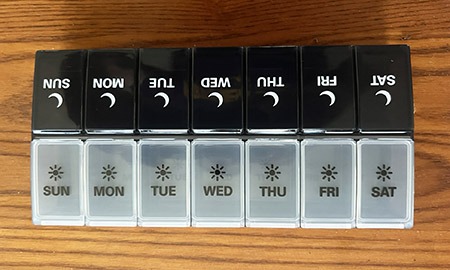
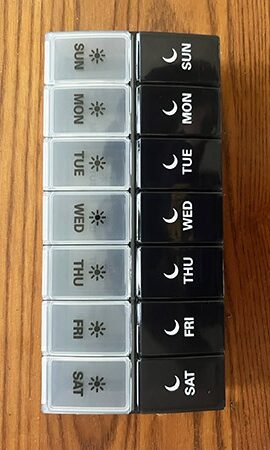
This second pill organizer – also a Class I device – addresses many of the issues seen in the first model.
What’s Better
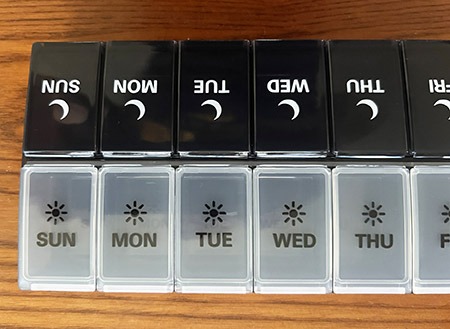
High contrast. Black for evening (moon icon) and translucent white for morning (sun icon) – immediately recognizable even in low light.
Universal symbols. The sun/moon imagery transcends language and literacy barriers.
Clear segmentation. Each day’s compartments are visually and spatially paired, reducing cognitive confusion.
Directional consistency. Labels and icons are oriented to match natural user interaction when opening the lids.
Remaining Opportunities
Even this design could benefit from small improvements – such as larger text for users with vision loss or tactile differentiation between AM and PM rows – but overall, it exemplifies the usability-focused mindset that the QMSR seeks to promote.
The contrast between the two pill organizers illustrates a powerful truth: Human-centered design doesn’t have to be expensive – it must only be intentional.
Note: In addition to the applicable references cited, reference FDA’s guidance document “Applying Human Factors and Usability Engineering to Medical Devices.”