Demonstrating Substantial Equivalence for U.S. Market Access
For most medical devices entering the United States market, the 510(k) Premarket Notification pathway is the primary regulatory route. A 510(k) submission demonstrates that a device is substantially equivalent to a legally marketed predicate device—allowing manufacturers to obtain clearance from the U.S. Food and Drug Administration and begin commercial distribution.
Medical Devices and Pharma (MDP) will support manufacturers through every stage of the 510(k) process, from early regulatory strategy through submission and clearance.
What Is a 510(k)?
A 510(k), or Premarket Notification, is required for most Class II (moderate-risk) medical devices, certain Class I (low-risk) devices, and significant modifications to legally marketed devices,
The purpose of the submission is to demonstrate that the device has the same intended use as a predicate device, is as safe and effective as that predicate, and does not raise new questions of safety or effectiveness.
When Is a 510(k) Required?
A 510(k) is typically required when introducing a new device with an existing market counterpart, making design or performance changes to a cleared device, or changing materials, software, or manufacturing processes that could impact safety or effectiveness.
When a 510(k) May Not Be Appropriate
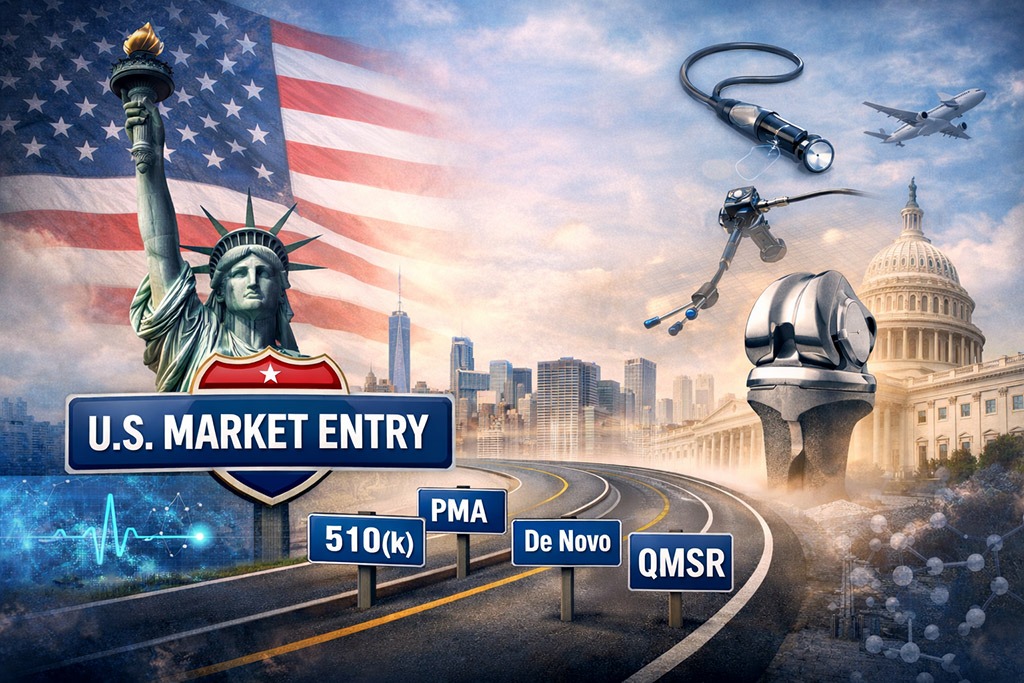
Alternative pathways may be required when no suitable predicate device exists (De Novo Classification), the device presents high risk (Premarket Approval (PMA)), or the device is exempt from premarket notification. Determining the correct pathway is a critical first step in U.S. market entry.
Types of 510(k) Submissions
Traditional 510(k)
The Traditional 510(k) is the original and traditional premarket notification pathway. A Traditional requires a more comprehensive submission than the other two types of 510(k)s, and is used for new devices or major changes.
Abbreviated 510(k)
An Abbreviated 510(k) submission relies on FDA guidance and recognized standards. It can have reduced documentation when conformity is well established.
Special 510(k)
A Special 510(k) is the least burdensome 510(k). It is for modifications to a manufacturer’s own cleared device and is based on design control documentation. This is often the fastest route when applicable.
What Does a 510(k) Include?
A typical 510(k) submission includes the following information:
- Device description and intended use
- Predicate device comparison
- Substantial equivalence rationale
- Performance testing:
- Bench testing
- Biocompatibility
- Software validation (if applicable)
- Risk analysis and mitigation
- Labeling and instructions for use
Most submissions follow the FDA’s structured eSTAR format, which standardizes content and improves review efficiency.
Electronic Submissions (eSTAR)
The FDA now requires all 510(k) submissions to be submitted electronically using the eSTAR (electronic Submission Template And Resource) system. The system features structured data requirements, built-in validation checks, and opportunities to reduce review cycles when properly prepared.
Common Challenges
Manufacturers attempting to prepare a 510(k) submission frequently encounter difficulty identifying appropriate predicate devices, misalignment between testing strategy and FDA expectations, incomplete or poorly structured substantial equivalence arguments, and/or delays due to FDA requests for additional information. These issues can significantly impact timelines and costs.
MDP Approach to 510(k) Success
MDP focuses on strategy-driven submissions, not just document preparation. We work with manufacturers to determine:
- Regulatory pathway and classification assessment
- Predicate device identification and justification
- Gap analysis and testing strategy development
- Alignment with FDA guidance and reviewer expectations
- Pre-Submission (Q-Sub) support when needed
- Full eSTAR preparation and submission management
Our objective is to reduce review cycles, minimize delays, and accelerate clearance
How 510(k) Fits Into U.S. Market Entry
The 510(k) is one of three primary U.S. device pathways. The other two are De Novo submissions for novel and moderate risk devices, and the premarket authorization (PMA) for high-risk medical devices that require clinical evidence prior to submission. Selecting the correct pathway, and executing it effectively, is essential to successful market entry.
Start Your 510(k) Strategy
If you are unsure whether your device requires a 510(k), or how to structure your submission, we can provide regulatory evaluations, pathway determination, and full submission support. Read more about our 510(k) services.
Request a 510(k) Assessment