Establishing a New Regulatory Classification for Novel Medical Devices
Not all innovative medical devices fit within existing regulatory frameworks. When a device is novel and lacks a legally marketed predicate but does not present the high risk associated with Class III devices it may be eligible for the De Novo classification pathway for entry to the U.S. market. The De Novo pathway provides a mechanism to establish a new device classification, enabling market entry while also creating a regulatory foundation for future devices.
What Is the De Novo Pathway?
The De Novo pathway is a regulatory process used to classify novel medical devices for which there is no legally marketed predicate device exists, general and/or special controls can provide reasonable assurance of safety and effectiveness, and the device presents low to moderate risk. A successful De Novo request results in the creation of a new device classification, the establishment of applicable regulatory controls, and the authorization to market the device in the United States.
When Is De Novo Appropriate?
The De Novo pathway is typically appropriate when a device is first-of-a-kind, a 510(k) submission is not possible due to lack of a predicate, the device does not require PMA-level clinical evidence, and risks can be mitigated through controls and targeted data. Typical examples of De Novo products are digital health and software-based devices, novel diagnostic technologies, and devices with new technological characteristics but moderate risk.
Two Approaches to De Novo
Manufacturers may pursue De Novo through one of two pathways.
After a Not Substantially Equivalent (NSE) Determination
If a sponsor submits a 510(k) and receives a Not Substantially Equivalent (NSE) determination, it can then submit a De Novo request.
Direct De Novo Request
A sponsor can submit a direct De Novo request without a prior 510(k). This is increasingly preferred for clearly novel devices.
How De Novo Fits Into U.S. Market Entry
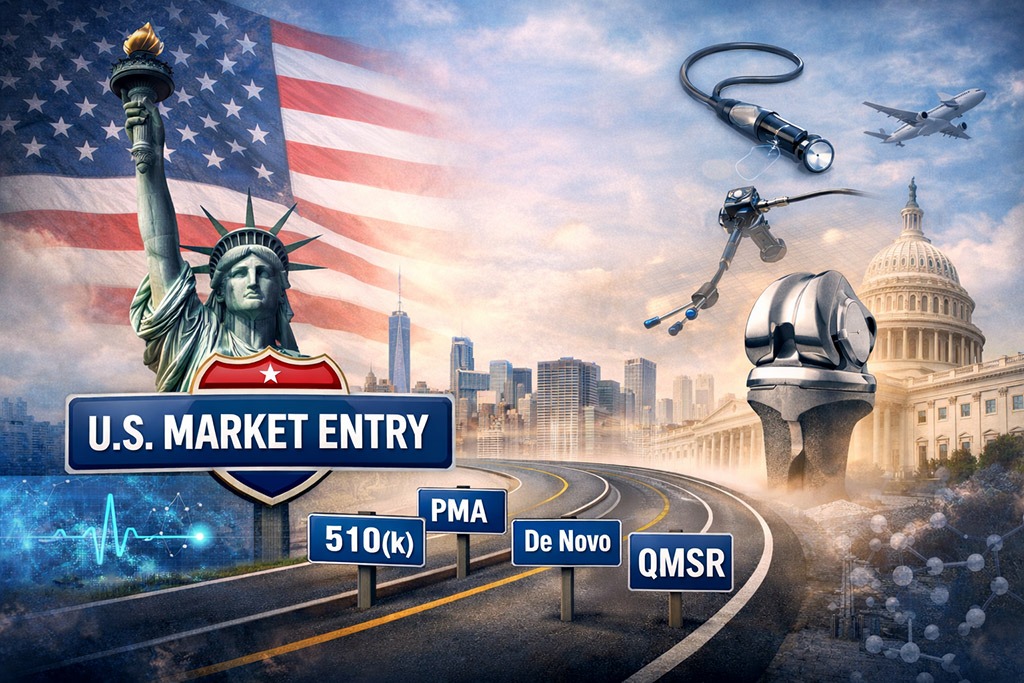
The De Novo pathway is one of three primary U.S. device pathways. A Premarket Notification 510(k) for a predicate-based clearance, a De Novo request for a novel, moderate-risk device, and a PMA for high-risk devices.
Selecting the correct pathway early is essential to avoid delays, reduce regulatory risk, and align development and testing strategies.
Evidence Expectations
While less burdensome than PMA, De Novo submissions still require a risk-based justification for classification, performance testing (bench, software, biocompatibility, etc.), and clinical data when necessary. The goal is to demonstrate reasonable assurance of safety and effectiveness.
Key Advantages and Common Challenges of De Novo
A De Novo market clearance pathway enables market entry for novel technologies, establishes a new classification regulation, creates a predicate device for future 510(k)s, and provides potential first-to-market advantage. Challenges that organizations encounter with a De Novo request include misclassification of device risk, uncertainty regarding data requirements, a lack of early regulatory alignment, and inefficient pathway selection.
Start Your De Novo Strategy
Determining whether your device is appropriate for the De Novo pathway requires careful evaluation of the device’s risk profile, intended use, technological characteristics, and available regulatory precedents. a structured regulatory assessment is critical to selecting the optimal pathway.
Contact Us for an evaluation of your De Novo strategy